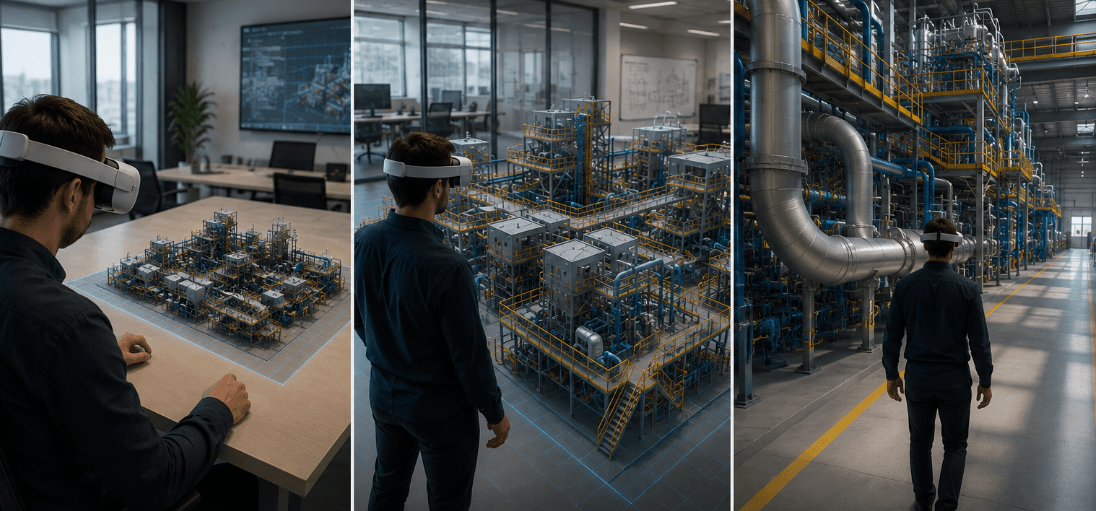
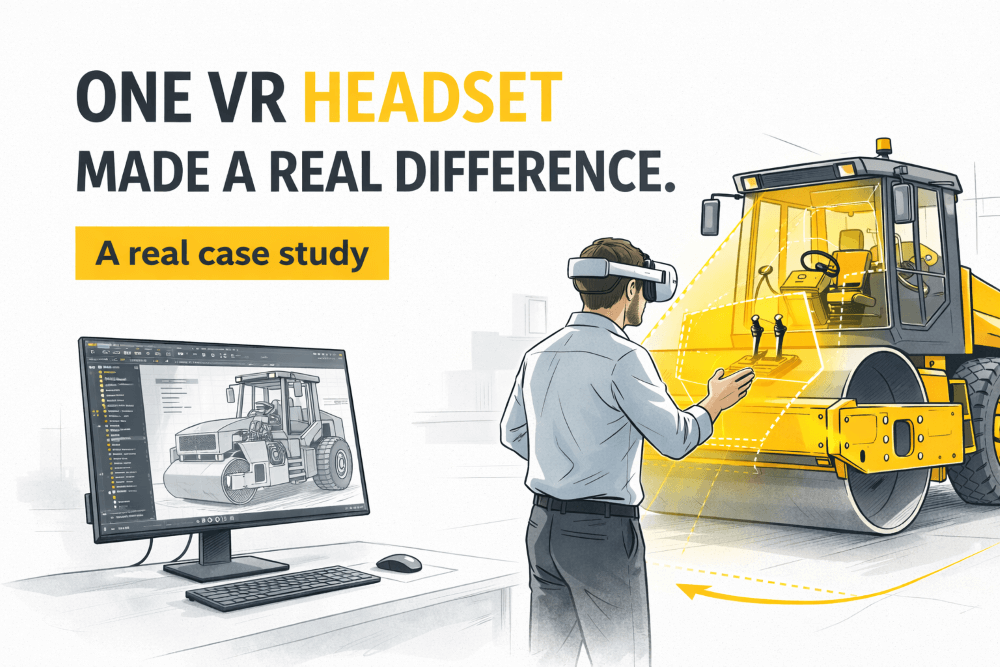
Can a single VR headset already improve how machines are developed?
Construction machinery, like a road roller, is large, complex, and expensive to prototype. At the same time, some design issues only become visible once a physical prototype exists — when changes are slow and costly. Virtual Reality offers a practical way to see and understand machines earlier. By bringing CAD models into a full-scale virtual environment, engineers can step inside the machine, check visibility and ergonomics, and review different design variants long before anything is built.
This case study shows how one international construction machinery manufacturer started with just one VR headset and moreViz to support design reviews, improve decision-making, and detect issues earlier. Even this first step delivered clear benefits — and there is much more potential ahead.
The challenge: complex machines, expensive prototypes, slow decision-making
Developing construction machinery is a demanding process. Machines are large, highly complex, and must perform reliably in harsh, real-world conditions. At the same time, they must meet strict safety and ergonomic regulations.
For engineers, this creates several important challenges:
Ensuring clear operator visibility in all working situations
Meeting ergonomic requirements for intuitive and comfortable control placement
Validating accessibility for service and maintenance tasks
Evaluating multiple machine variants and configuration options
Traditionally, these aspects were reviewed using CAD models, physical mockups, and prototypes. While CAD provides precise geometry, it cannot fully convey how a machine feels in real scale. Visibility limitations, uncomfortable control positions, or restricted access often only became obvious once a physical prototype existed.
At that point, design changes required significantly more time, effort, and cost. The manufacturer was therefore looking for a practical way to review large road roller machines earlier, identify potential issues sooner, and make better design decisions before building physical prototypes.
Keep it simple: bringing CAD directly into VR with moreViz
Virtual Reality provided what traditional CAD reviews could not: a real sense of space. While CAD models are precise, they are still viewed on a flat screen. VR allowed engineers to experience the machine in true 1:1 scale and from the operator’s perspective. This made it much easier to evaluate visibility, ergonomics, and accessibility in a realistic way.
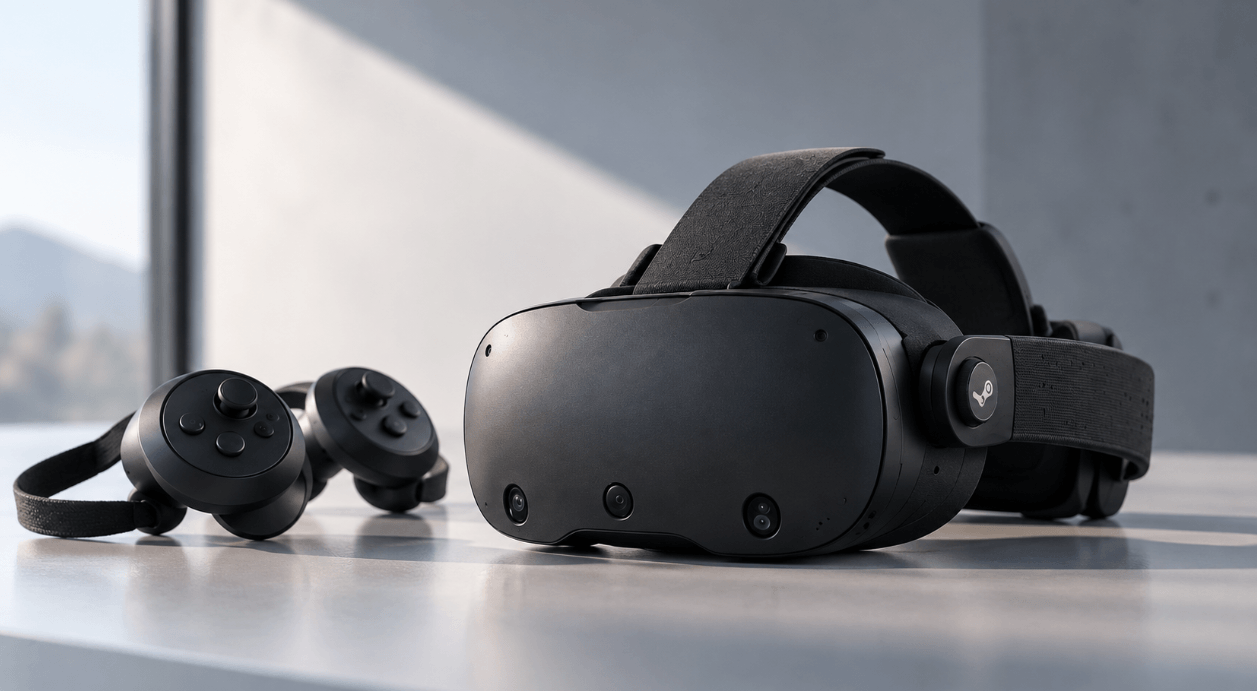
The manufacturer started with a single Meta Quest 3 headset. Using moreViz, engineers could mirror their existing CAD models directly into Virtual Reality without conversion or additional preparation. This made it easy to integrate VR into the existing workflow without changing established tools or processes.
moreViz connects directly to CAD software in use, including Siemens NX, Solid Edge, and the JT ecosystem. This made Virtual Reality easy to use in everyday engineering work. After a short introduction, team members could independently display models in VR, review designs, and evaluate specific questions.
“After the initial configuration, it just took five minutes of trial and error play time, and anyone could get started with moreViz. This user-friendliness was important to us.”
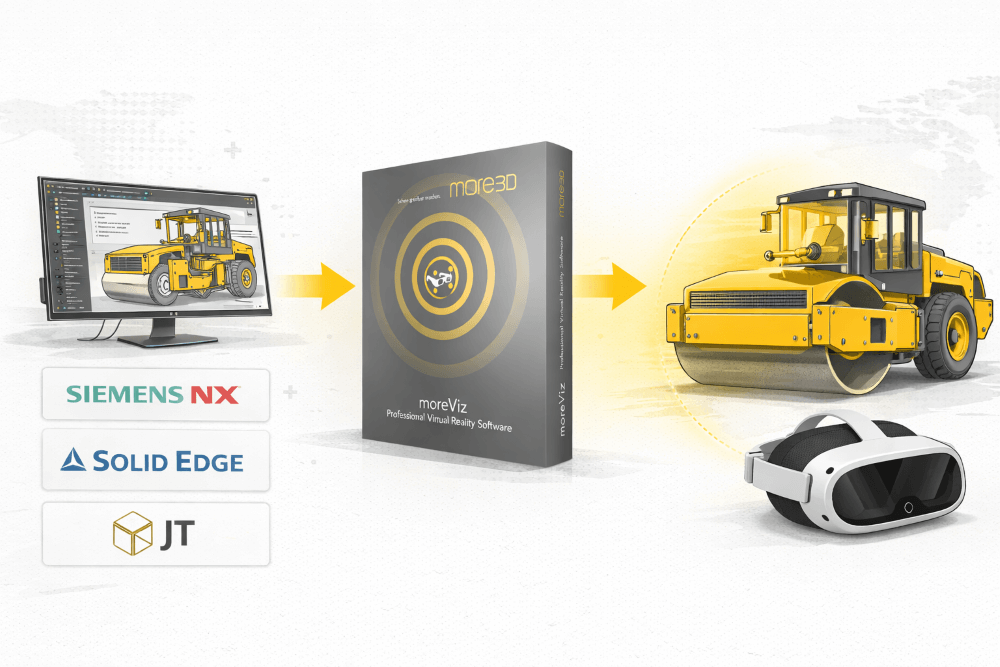
Additionally, moreViz provides a simple and intuitive interface for navigation and practical tools during VR sessions. This flexibility was a key reason for choosing the solution, as it allowed the team to focus on reviewing and improving designs rather than managing complex VR workflows.
How VR is saving money: validating designs and comparing variants
Virtual Reality is now used regularly to review design decisions that were previously difficult to evaluate. Engineers can step inside the virtual machine, take the operator’s position, and assess visibility, ergonomics, and spatial constraints in real scale. This makes it easier to confirm whether a design meets safety requirements and practical usability expectations.
“You can measure many things in CAD, but only in VR do you truly feel whether it really works — whether visibility is clear, whether the control console is in the way, and whether the ergonomics are right.”
VR is especially valuable when comparing component variants. Engineers can position and replace components directly in the virtual environment. Instead of creating physical mockups or separate prototype assemblies, different variants can be reviewed and compared within minutes.
One practical example was the selection of the machine’s headlights. Multiple options needed to be evaluated. In Virtual Reality, engineers could view all variants in real scale and compare them directly in the context of the road construction machine.
This allowed the team to make a clear and confident decision much faster. Instead of relying only on measurements or renderings, everyone involved could immediately see how each variant fit and performed. This saved time and helped avoid design changes later in development.
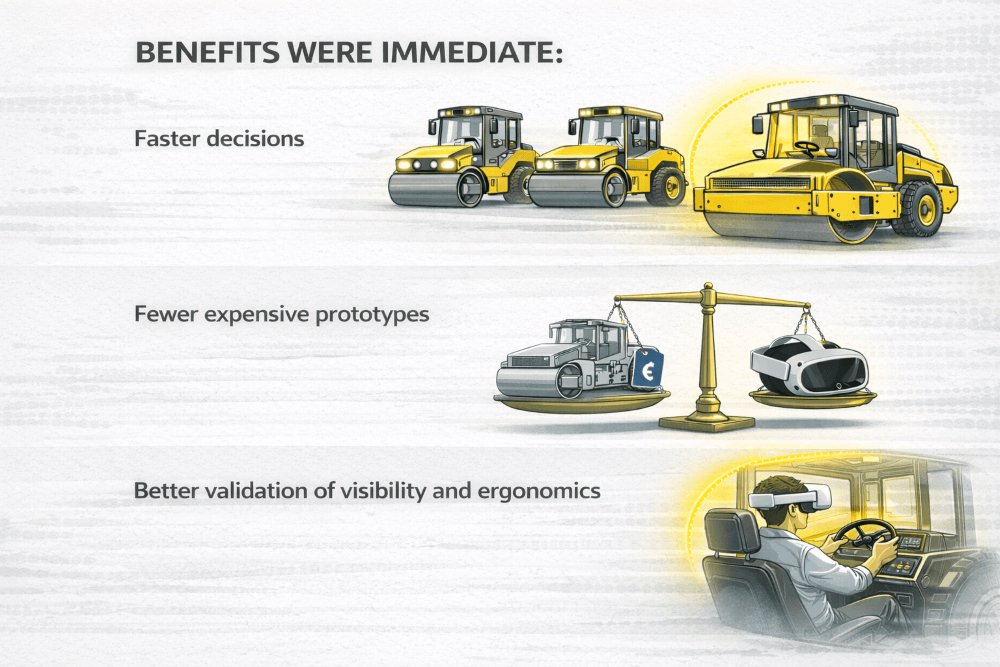
Even with just one VR headset, the benefits were immediate:
Faster decisions: Design variants could be reviewed and decided directly in VR.
Fewer physical prototypes: Many questions were clarified virtually, saving time and material.
Better validation of visibility and ergonomics: Requirements could be checked and experienced in real scale.
"Virtual Reality quickly became a simple and practical extension of the existing development process."
Tap into VR’s potential: what comes next to expand VR across teams
The customer is still at an early stage of using Virtual Reality, but the next steps are already defined. After the successful introduction with a single VR headset, the company plans to expand the use of VR gradually across teams and locations.
Additional headsets may be introduced over the next 6–12 months, allowing engineers in different departments and countries to review designs in parallel.
This will enable new forms of collaboration:
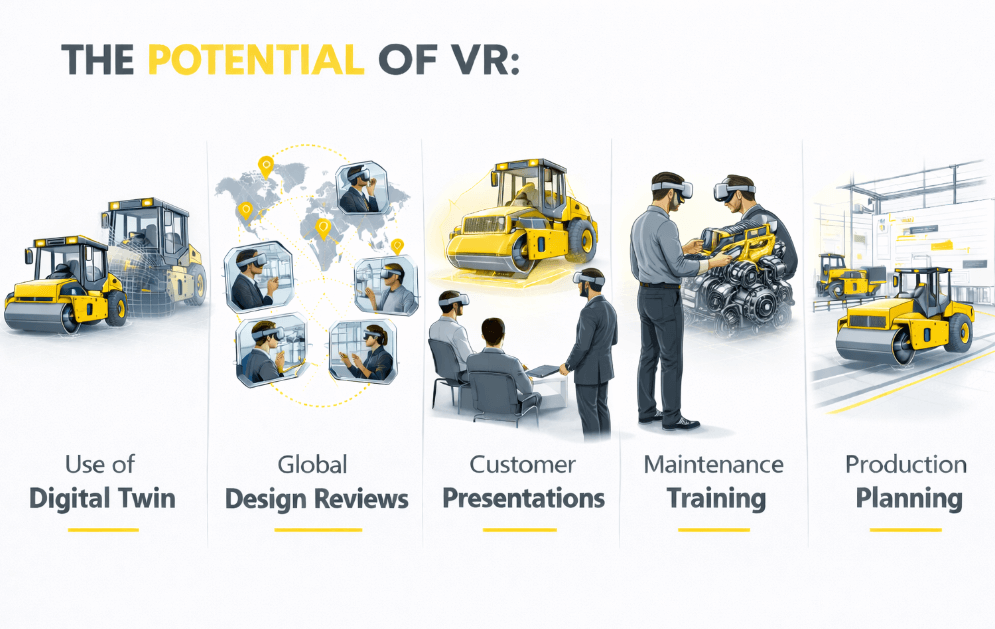
Global design reviews: Teams can meet inside the same virtual machine, regardless of location.
Faster alignment: Visibility, ergonomics, and installation space can be evaluated together.
Fewer misunderstandings: Everyone sees and experiences the same design in real scale.
The introduction of digital twins is also planned, enabling fast switching between different configurations. Body panels, lighting options, or equipment packages can be reviewed and compared instantly.
Beyond engineering: VR opens new opportunities
Along the product life-cycle VR unlocks even more potential:
Customer presentations: Machines can be experienced in a virtual showroom before they are built. This allows customers to review configurations early, improves communication, and helps avoid costly misunderstandings.
Service preparation: Maintenance procedures can be reviewed and optimized, and users can be guided or trained on service tasks, including which components to access or remove — safely and even remotely.
Production planning: Assembly steps, component accessibility, and factory layouts can be reviewed and optimized virtually before implementation.
What started with a single VR headset is now developing into a broader capability. Virtual Reality is becoming a practical tool to improve development, collaboration, and decision-making — with clear potential for further expansion.
Conclusion: a simple step with real impact
This project showed that Virtual Reality is not a future concept — it is a practical tool that already improves daily engineering work. With just one headset and moreViz, the team was able to review designs more clearly, decide faster, and detect issues earlier — by adding something CAD models alone cannot provide: real spatial understanding.
What started as a small and low-risk step has already delivered measurable value — and opened the door to many more possibilities.
If you are curious how your own machines look and feel in Virtual Reality, moreViz can be tested free of charge for 14 days using your existing CAD models: www.more3d.com