10 common misconceptions that sound reasonable … but often miss what actually matter
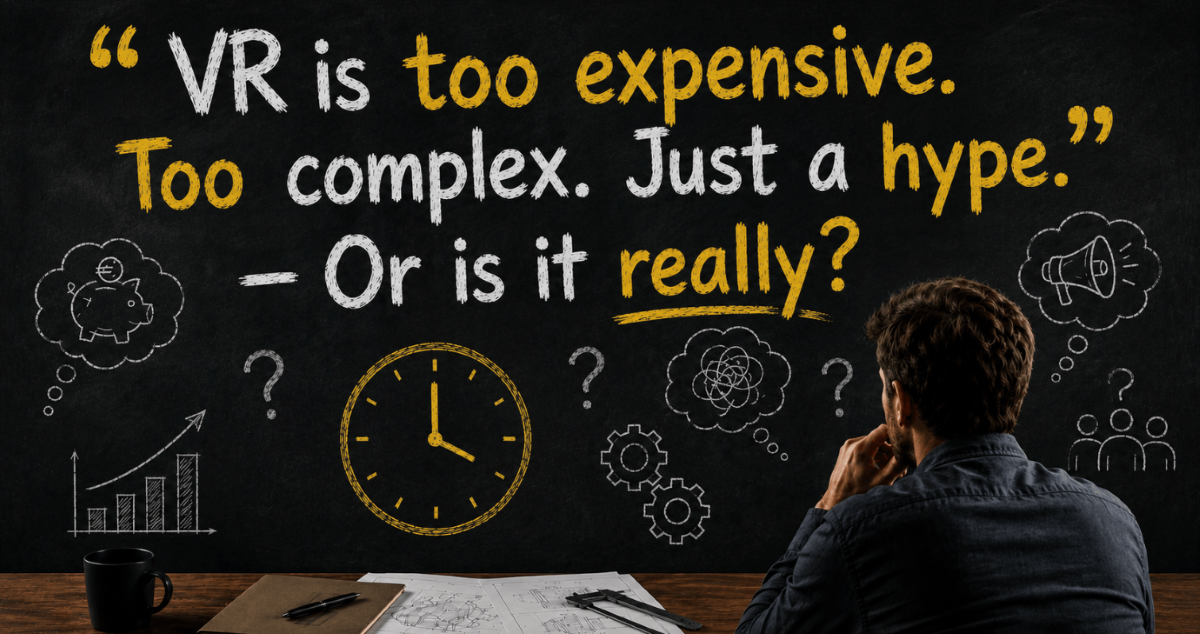
If you bring up Virtual Reality in a serious engineering or business discussion, you can almost predict the reactions. Someone will question the cost. Someone will doubt the practicality. And someone will quietly think: “We’ve managed without it so far.”
None of this is wrong.
In fact, these objections are exactly what responsible decision-making should look like. Especially when budgets, workflows, and real-world impact are involved.
But here’s the underlying issue:
Most concerns about VR are based on outdated experiences, incomplete information — or simply the wrong expectations.
This article takes those objections seriously. Not to dismiss them, but to understand where they come from — and where they still hold up.
1. “VR is just a hype that’s already over.”
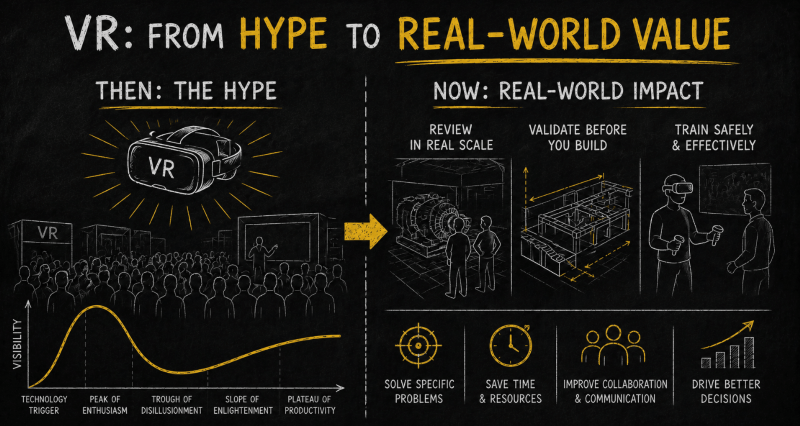
A few years ago, VR was everywhere. Trade shows, press releases, bold promises about revolutionizing entire industries. Then, suddenly, things got quieter.
It’s easy to interpret that as failure. But what actually happened is something far more typical for new technologies: VR moved past the hype cycle and into real-world application.
Instead of trying to impress large audiences, it started solving very specific problems for very specific users. Today, VR is used where it actually delivers measurable value:
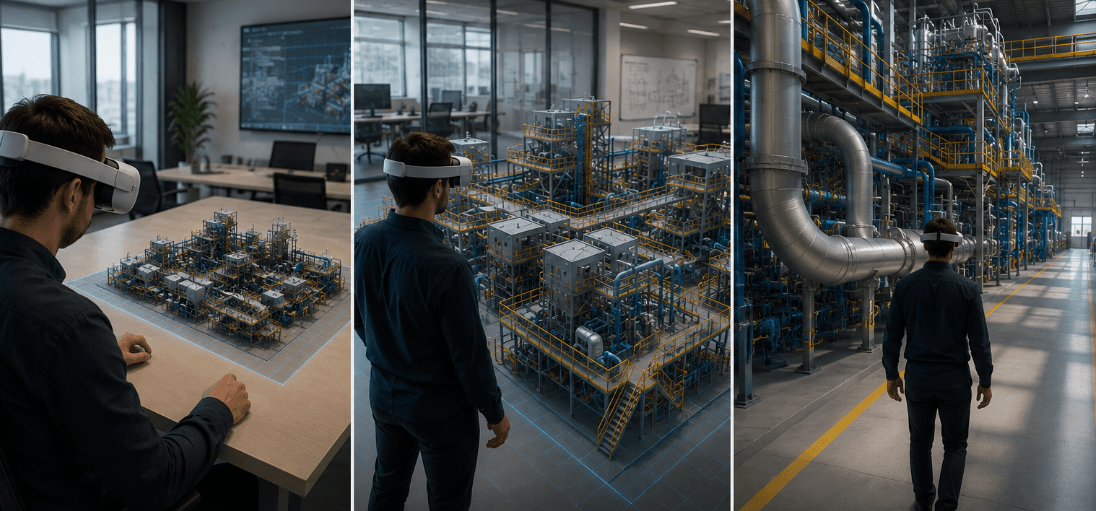
Reviewing complex designs in real scale
Validating layouts before anything is built
Training in controlled, repeatable environments
In other words, VR didn’t disappear. It became more focused — and more useful.
The companies using VR successfully today are not chasing trends. They are addressing challenges that traditional tools struggle with, especially when it comes to spatial understanding. (Read more about a real life example here).
2. “VR is too expensive.”
This is probably the most common concern — and one of the most justified ones. Yes, depending on the setup, VR can require a noticeable investment. Especially when we talk about larger installations like a VR CAVE.
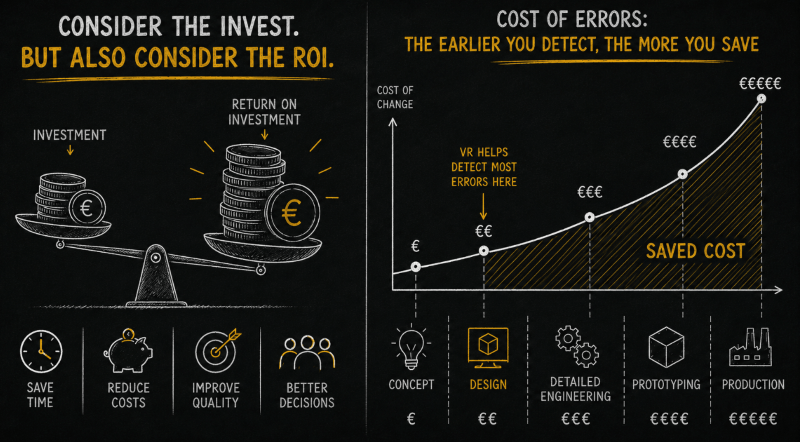
But evaluating VR purely based on cost is like evaluating a machine based only on its purchase price. The more relevant question is:
Where does VR reduce costs that already exist in your process?
In many engineering and planning workflows, inefficiencies are accepted as part of the process:
Late design changes because something wasn’t fully understood
Miscommunication between teams working on the same model
Physical prototypes that reveal issues too late
Travel for reviews that could have been avoided
These costs rarely appear as a single line item—but they accumulate over time.
VR doesn’t eliminate all of them. But it shifts problem detection earlier, where changes are still manageable and significantly cheaper. And importantly, implementation does not have to start with a large investment. (Read here a real case study to showcase this).
Many companies begin with a focused use case and scale based on actual results. This is also where solutions like moreViz play a role — not by replacing existing systems, but by making it easier to use what is already there in a more effective way.
3. “We don’t have clear use cases.”
A clear use-case is definitely crucial for a successful VR project. Because if a tool doesn’t fit into an existing workflow, it simply won’t be used.
The problem is that many organizations approach VR from the wrong direction. They start with the technology and ask: “Where could we use this?”
A more effective approach is to look at existing challenges:
Where do teams struggle to fully understand spatial relationships?
Where do misunderstandings occur repeatedly?
Where do issues only become visible late in the process?
That’s where VR becomes relevant.
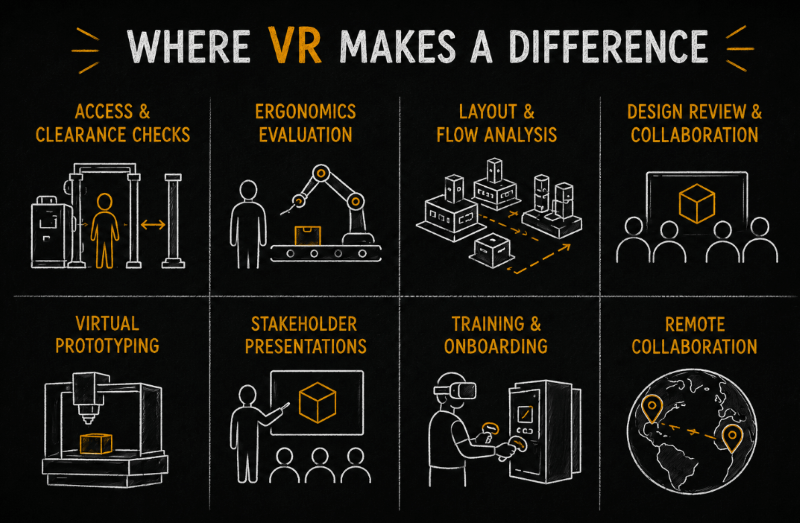
Typical use cases are rarely spectacular — but highly practical:
Checking whether maintenance access is actually feasible
Evaluating ergonomic conditions for operators
Understanding scale in large production layouts
Communicating designs to stakeholders without technical background
These are not futuristic scenarios. They are everyday challenges. VR simply provides a better way to handle them.
4. “VR is too complicated to use.”
This perception has a clear origin. Early VR systems were often difficult to set up and even harder to integrate into daily work. They required training, patience, and sometimes a dedicated operator.
That doesn’t align well with fast-paced engineering environments. Today, expectations have changed. A tool that requires extensive onboarding is unlikely to be adopted — no matter how powerful it is.
Modern VR solutions focus heavily on usability:
Fast access to data
Intuitive navigation
Minimal technical barriers
The goal is straightforward: VR should feel like a natural extension of your existing tools — not a separate system you have to learn from scratch.
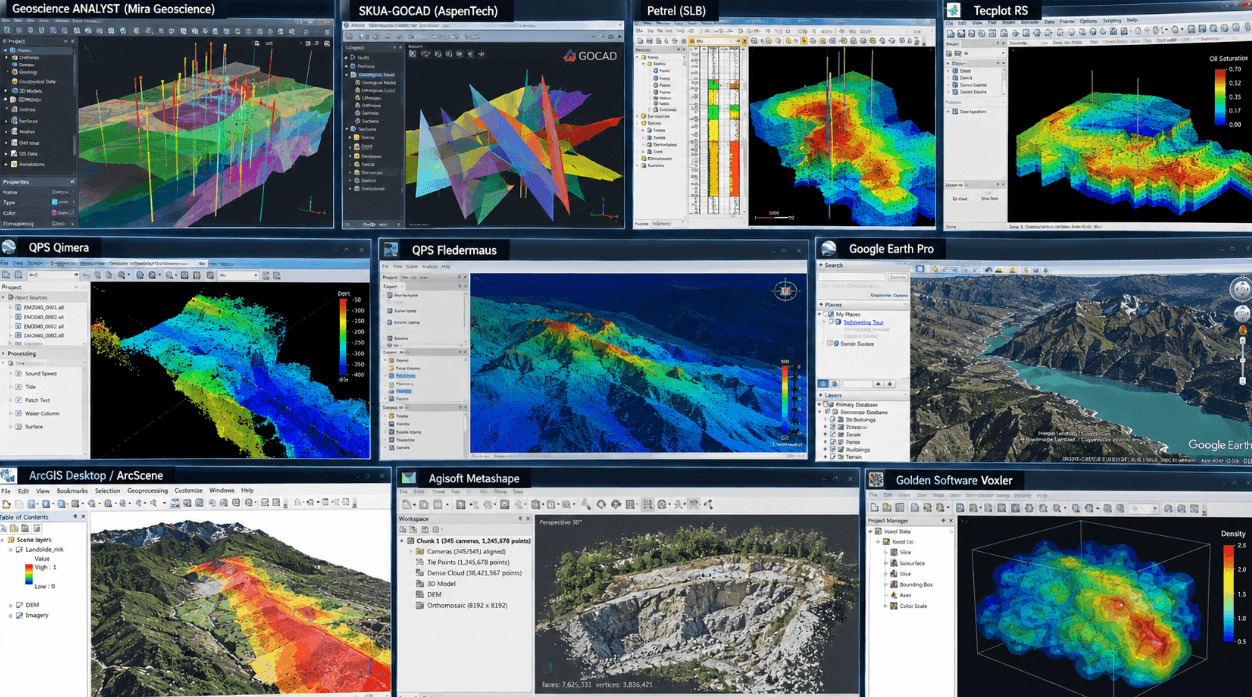
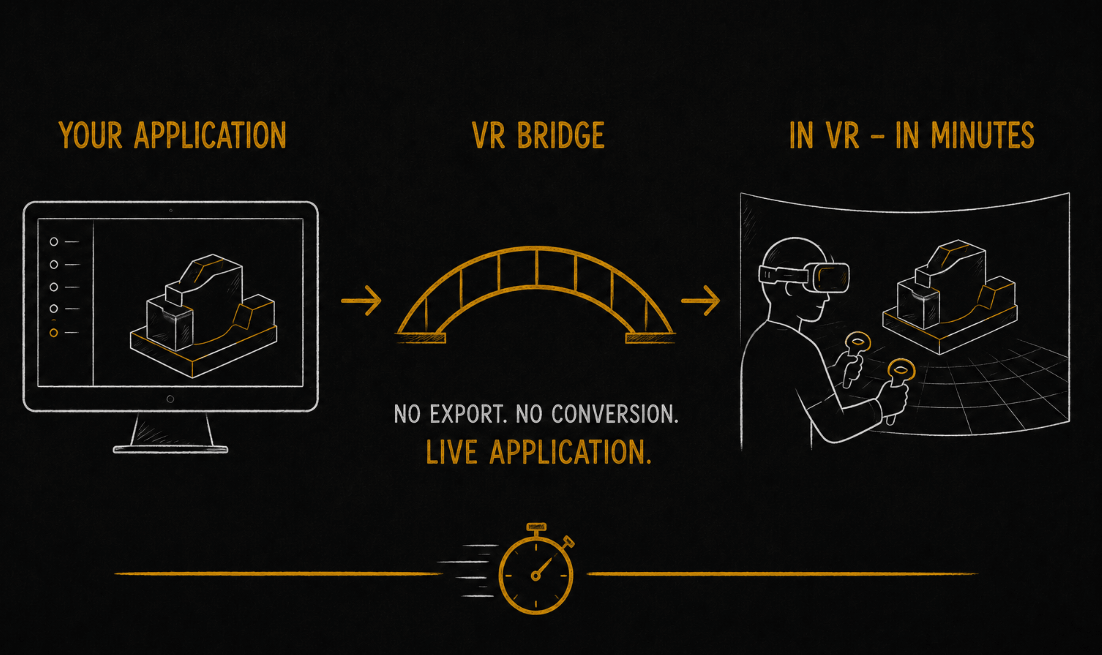
This is one of the key reasons why approaches like a VR application bridge like moreViz are gaining relevance. Instead of exporting and converting data, users can interact with their familiar applications directly in VR.
The less friction there is, the more likely it is that VR becomes part of everyday work — not just a demonstration tool.
5. “We don’t have the resources to implement it.”
Introducing any new technology comes with overhead. Who will manage it? Who ensures it runs smoothly? Who supports users when something doesn’t work?
These are valid concerns — and they often slow down adoption. But they are also often based on the assumption that VR must be rolled out across the entire organization at once.
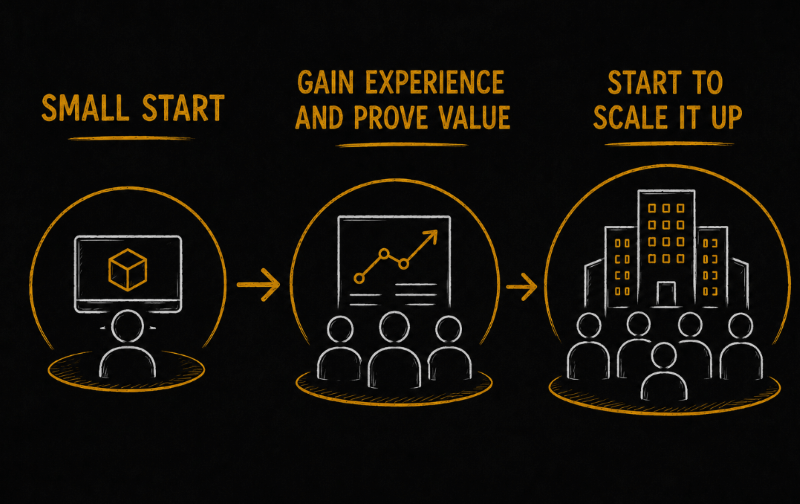
In practice, successful implementations follow a different path. They start small. A single team. A clearly defined use case. A controlled environment.
From there, experience builds. Processes adapt. And decisions about scaling are based on actual results — not assumptions.
Another important factor is integration.
If VR requires completely separate workflows, it creates additional effort. If it integrates into existing systems, it becomes much easier to maintain. This is exactly where streamlined solutions become relevant — reducing the need for additional steps, duplicated data, or complex preparation processes.
6. “VR is just a nice-to-have.”
True, you can design, plan, and build without VR. That has been proven for decades. But that doesn’t mean the current approach is optimal.
Many inefficiencies are simply accepted:
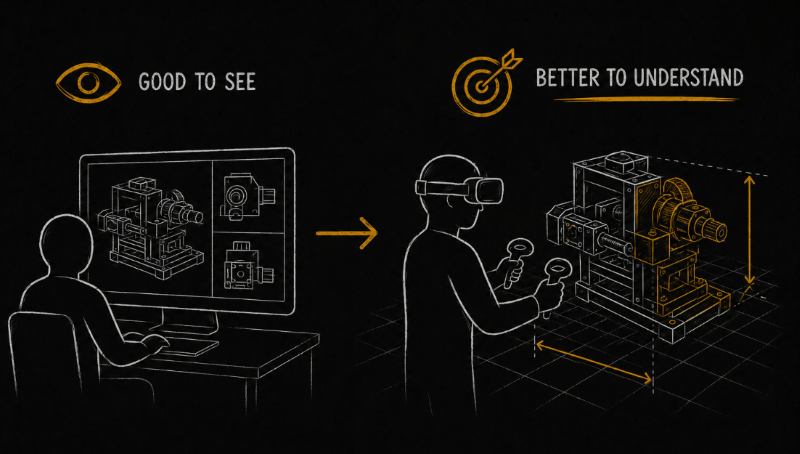
Interpreting 3D models on 2D screens
Estimating scale instead of experiencing it
Discovering problems only after implementation
VR does not replace existing tools. It complements them — specifically in situations where spatial understanding is critical. Think of it less as a constant tool and more as a targeted instrument.
You don’t use it all the time. You use it when it makes a difference. And in many industries, that moment occurs more often than expected.
7. “The simulation doesn’t feel realistic enough.”
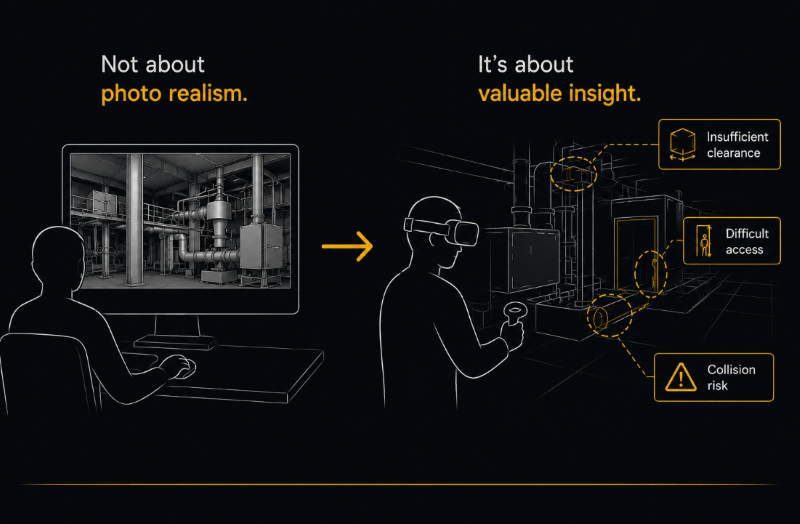
There is a common assumption that VR must be visually perfect to be useful. But realism is not just about graphics. In many professional applications, what matters more is:
Accurate scale
Correct positioning
Reliable interaction
Even relatively simple visualizations can provide valuable insights if they represent space correctly. You don’t need photorealism to identify:
Collisions between components
Insufficient access areas
Inefficient layouts
In fact, excessive visual detail can sometimes distract from the actual task. The goal is not to replicate reality perfectly. It is to understand it better.
8. “People don’t feel comfortable using VR headsets.”
Some users experience discomfort. Others don’t like being isolated from their surroundings. These concerns are valid — and they should be taken seriously.
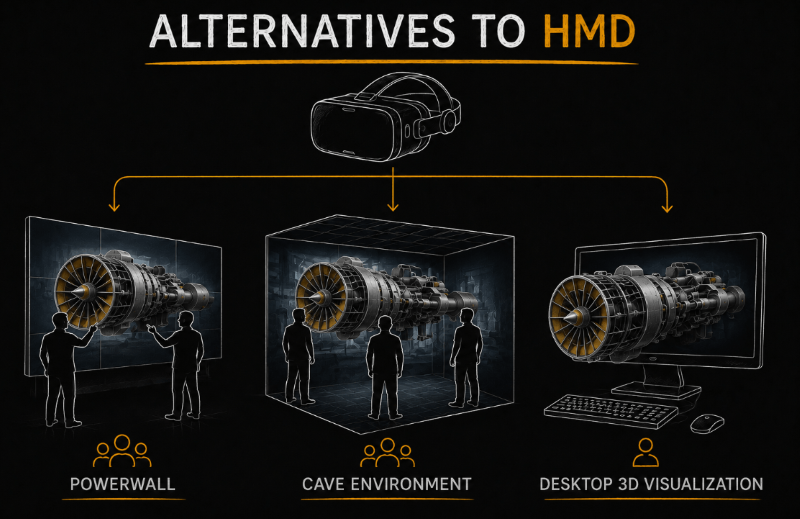
But they also highlight an important point: :
Powerwalls for collaborative discussions
CAVE environments for immersive group experiences
Desktop-based 3D visualization for quick access
Choosing the right system depends on the use case — not the other way around. In many professional environments, shared experiences without headsets are actually more effective, especially when collaboration is the main goal.
9. “VR takes too long to prepare.”
Traditional workflows can involve multiple steps before anything is visible in VR:
Exporting data
Converting formats
Adjusting models
Fixing errors
This creates delays and additional workload. However, this is not a limitation of VR itself — it is a limitation of how VR is integrated.
Newer approaches focus on eliminating these steps entirely by connecting applications directly to VR environments. Instead of preparing data for VR, users can work with their existing applications in real time.
This is where solutions like moreViz become particularly relevant. By acting as a bridge between applications and VR systems, it allows users to access their data without conversion or duplication.
10. “We’ve managed without VR so far.”
And it’s true. Projects have been completed successfully without VR for years. So why change?
Because many inefficiencies are invisible until a better alternative exists. Consider how often teams deal with:
Misinterpretations during design reviews
Late-stage corrections
Repetitive discussions to clarify spatial issues
These are not failures. They are part of established workflows. But they also represent opportunities for improvement. VR does not introduce new capabilities — it enhances existing ones.
It allows teams to:
See instead of imagine
Validate instead of assume
Communicate more clearly across disciplines
What actually matters when evaluating VR
At this point, one thing should be clear: Most objections to VR are not fundamentally wrong.
They are based on real concerns — cost, complexity, usability. But in many cases, they are applied to outdated assumptions or to solutions that were simply not the right fit.
So instead of asking “Is VR good or bad?”, the better question is: “Does VR make sense for our specific challenge?”
And this is exactly where the difference lies. Not in the technology itself, but in how it is applied.
VR is not a miracle solution. It won’t fix poor processes. It won’t replace expertise or experience. But it does something very simple — and very valuable:
It turns abstract information into something you can actually experience.
And in environments where decisions depend on understanding space, scale, and interaction, that shift can make a measurable difference.
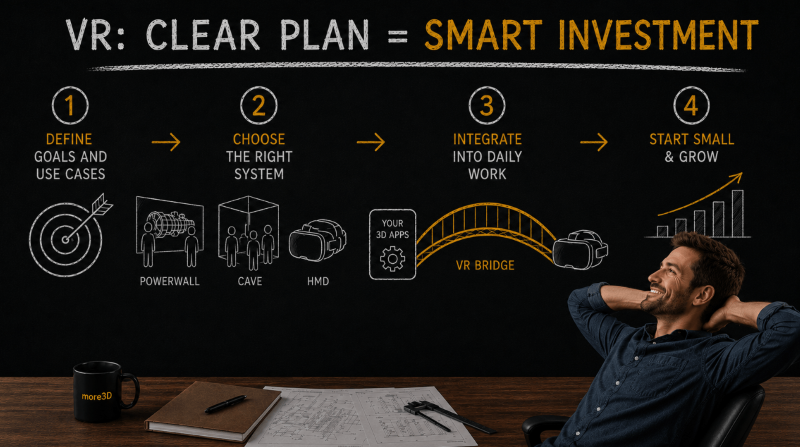
Curious what this could look like in your workflow?
If you’re currently dealing with complex 3D data, unclear layouts, or time-consuming design reviews, it might be worth taking a closer look.
Solutions like moreViz are designed to make this step as simple as possible—by bringing your existing applications directly into VR, without conversion or disruption of your workflow.
No big promises. No overcomplication. Just a practical way to test whether VR actually improves how you work. Test it out for free.