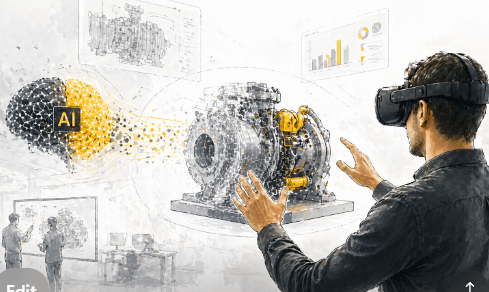
Artificial Intelligence is currently being added to almost everything. Virtual Reality is no exception. New features, new tools, new promises—often bundled under the same headline: “AI-powered tool.”
That naturally raises a fair question: Is AI in VR actually useful—or just another hype with a lot of marketing buzzwords?
Especially for companies that already use VR, this is not a theoretical discussion. It’s a practical one. Does AI improve what you already have? Or is it just a waste of time and money?
Moving Beyond the Buzzwords of AI and VR
To answer this question properly, it is important to separate two things that are often mixed together: the idea of AI in VR, and the actual implementation of it.
The idea is easy to sell. AI sounds intelligent, adaptive, almost autonomous. Combined with immersive visualization, it creates a powerful narrative of “next-generation workflows.” But engineering environments are not driven by narratives. They are driven by precision, repeatability, and efficiency.
This is why many AI-driven features in VR fail to convince experienced users. Not because AI is inherently flawed, but because it is often applied at the wrong level—focusing on experience instead of process.
The real opportunity lies deeper in the workflow.
Understanding the VR Pipeline: Where AI Can Intervene
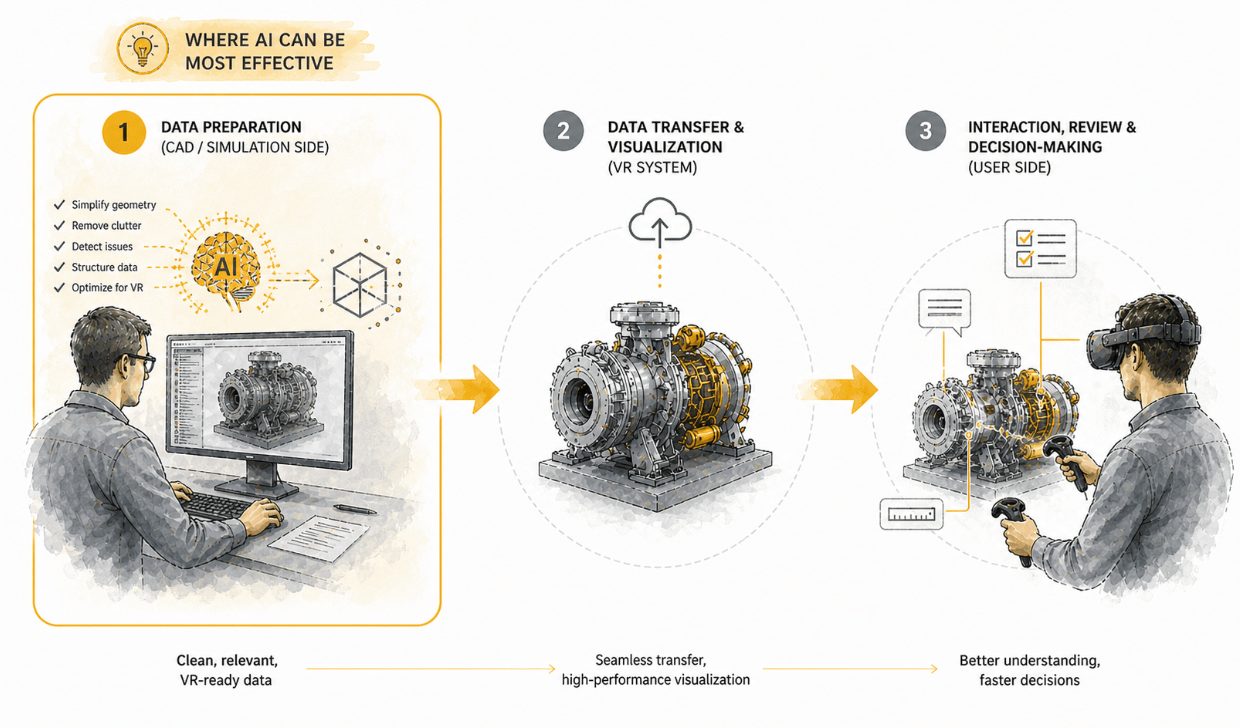
To evaluate whether AI adds value, it helps to break down what actually happens in a VR workflow. Simplified, it consists of three stages:
Data preparation (CAD / simulation side)
Data transfer and visualization (VR system)
Interaction, review, and decision-making (user side)
Most discussions around VR focus on the third stage—the experience itself. But from a productivity perspective, the first stage is often the most critical.
This is where models are prepared, simplified, and structured. It is also where the majority of time is spent in complex projects. And this is precisely where AI can have the strongest impact.
AI as a Pre-Processing Engine, Not a Visual Feature
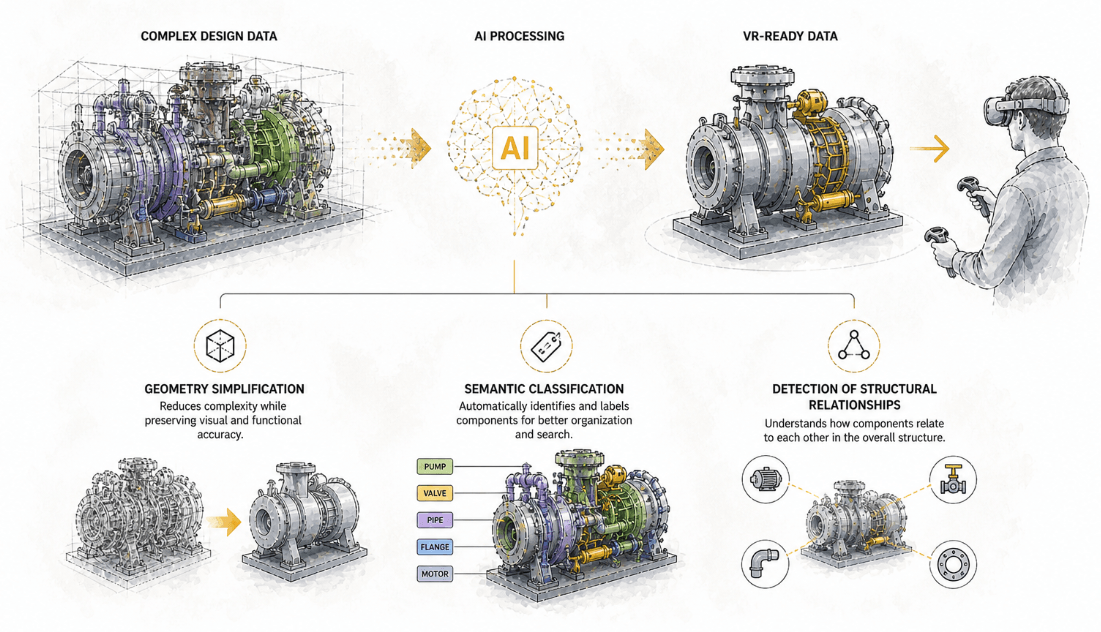
Instead of trying to make VR “smarter,” AI can make the data that feeds into VR more usable. This includes tasks such as:
- geometry simplification
- semantic classification of components
- detection of structural relationships
These are not trivial tasks. In large assemblies, they involve analyzing thousands of components and understanding how they relate to each other. Traditionally, this requires manual effort and domain expertise. AI can accelerate this by learning from patterns across multiple models and use cases.
The Role of Geometry Simplification: More Than Just Performance
Geometry reduction is often framed as a performance issue. Lower polygon counts lead to smoother VR experiences. While this is true, it only scratches the surface.
The deeper challenge is relevance.
Engineering models are built with a level of detail that exceeds what is needed for decision-making in VR. Threads on screws, internal cavities, or micro-features are essential for manufacturing—but irrelevant for spatial understanding.
AI-based simplification goes beyond simple decimation algorithms. It can:
- classify components based on function and context
- preserve critical geometry while simplifying secondary elements
- maintain visual coherence even after reduction
This leads to models that are not only lighter, but also cognitively easier to process. In other words, AI does not just improve performance—it improves clarity.
Semantic Understanding: The Key Differentiator
One of the limitations of traditional VR preparation workflows is the lack of semantic understanding. A system may know that a model contains 10,000 parts—but not what those parts represent. AI changes this by introducing classification.
Through pattern recognition and training data, AI can distinguish between:
- fasteners and structural components
- moving and static parts
- functional interfaces and decorative elements
This enables more intelligent decisions during preparation.
For example, instead of applying a uniform simplification rule, the system can treat different categories differently. Critical interfaces remain detailed, while repetitive elements are aggressively reduced. This level of differentiation is difficult to achieve manually at scale.
Structural Optimization: Making Models Navigable
Another often underestimated factor in VR usability is model structure. Even when geometry is optimized, poorly structured models can still be difficult to work with. Navigation becomes inefficient, and collaboration suffers when users cannot quickly isolate relevant components.
AI can analyze hierarchical relationships and reorganize models based on usage patterns. This includes:
- grouping components by function rather than origin
- flattening overly complex hierarchies
- defining logical visibility states
These changes may seem subtle, but they have a significant impact on how users interact with the model in VR. A well-structured model reduces cognitive load. Users spend less time searching and more time understanding.
AI and Analysis: Supporting Decision-Making
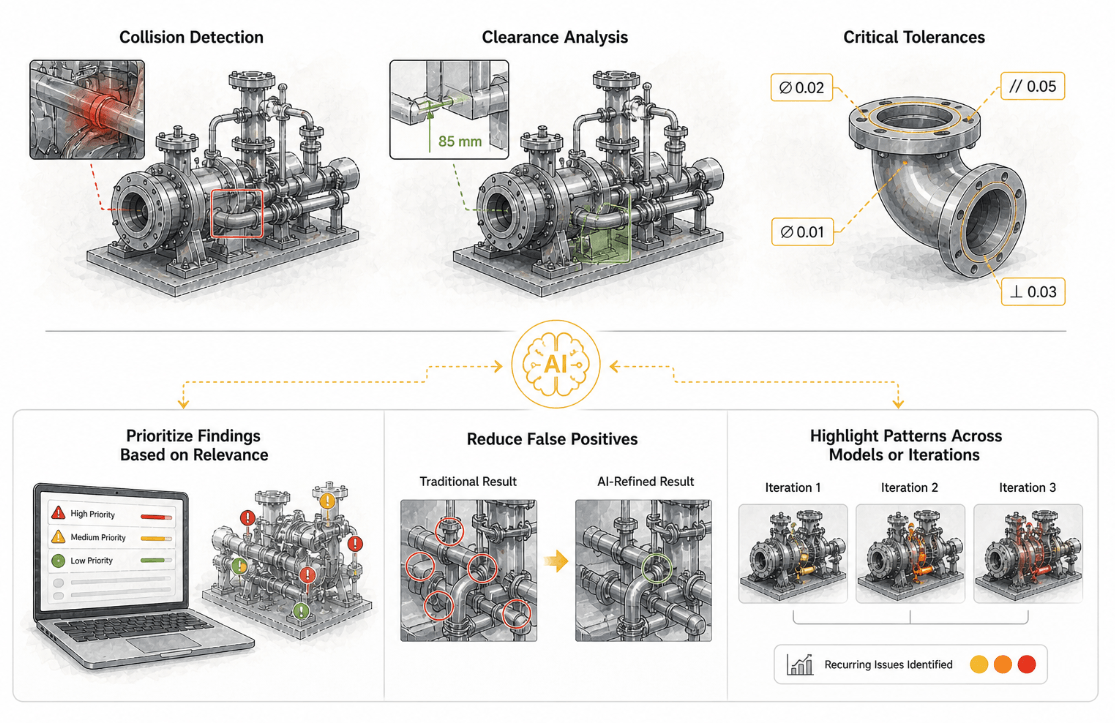
Beyond preparation and structure, AI can also contribute to analytical tasks. In engineering contexts, this includes:
- collision detection
- clearance analysis
- identification of critical tolerances
While these functions already exist in many CAD systems, AI can enhance them by:
- prioritizing findings based on relevance
- reducing false positives
- highlighting patterns across multiple models or iterations
In a VR context, this means users enter the environment with a clearer focus. Instead of scanning the entire model, they can concentrate on areas that are likely to require attention. This improves both efficiency and decision quality.
Integration: The Often Overlooked Constraint
Even the most advanced AI capabilities are only as valuable as their integration into the workflow. If AI requires separate tools, additional data exports, or complex configuration, it introduces friction.
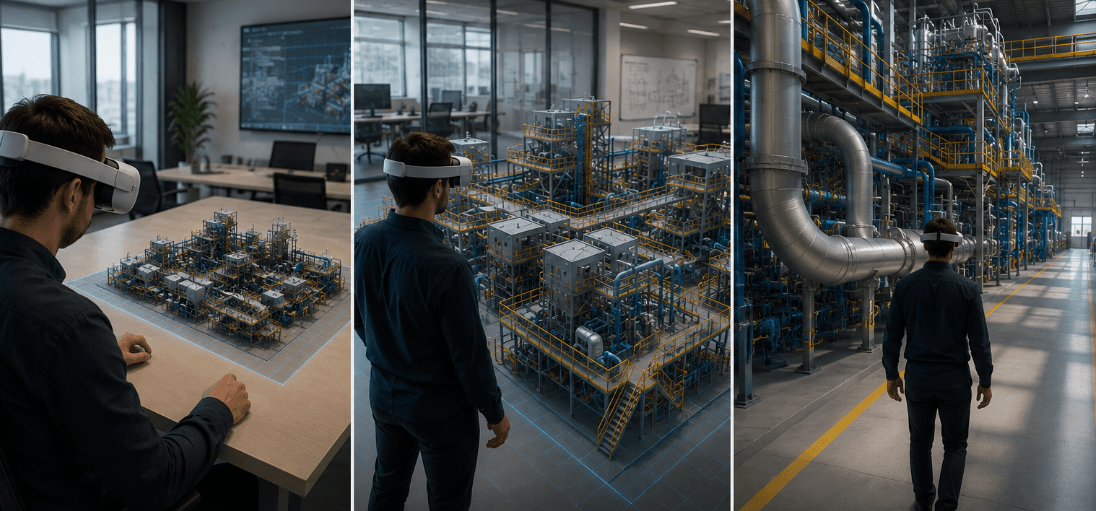
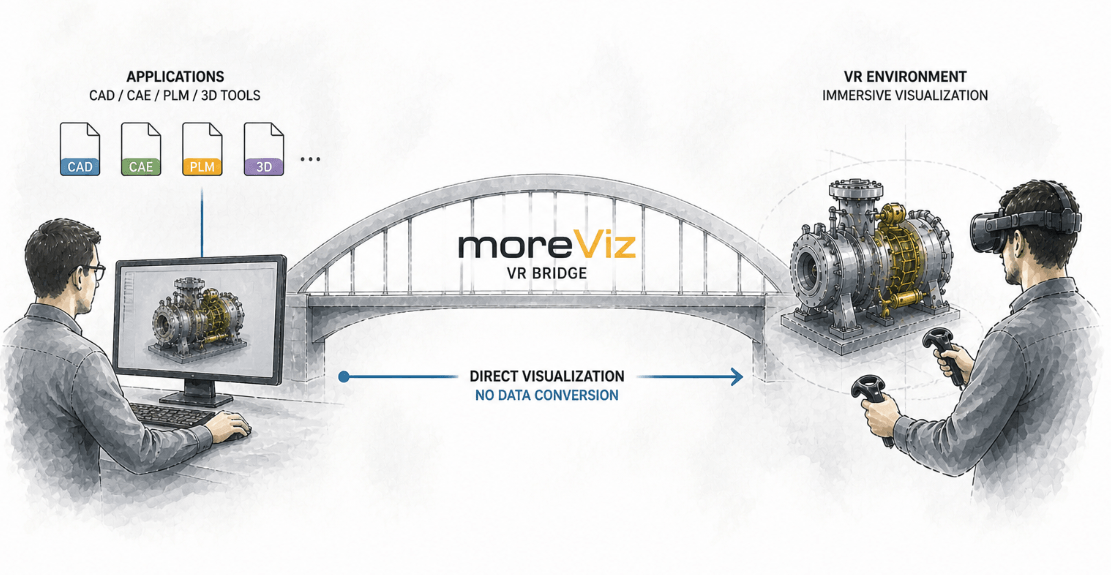
And friction is exactly what most VR workflows try to avoid. This is why integration with existing systems is critical. Solutions like moreViz address this by enabling direct visualization of applications in VR without data conversion. This eliminates a major source of inefficiency.
A VR bridge like moreViz eliminates a major source of inefficiency by enabling direct visualization.
When AI-driven preparation is combined with direct-to-VR workflows, the result is a system where:
- data flows seamlessly
- preparation steps are minimized
- users can focus on analysis rather than setup
This is where AI moves from theoretical value to practical impact.
The Limits of AI in VR
Despite its potential, AI is not a universal solution. There are clear limitations. First, AI depends on data quality. Poorly structured or inconsistent models can reduce its effectiveness.
Second, AI requires transparency. In engineering, users need to understand what the system is doing. Black-box decisions are difficult to trust.
Third, AI is most effective in repetitive tasks. Highly specialized or unique scenarios still require human judgement. Recognizing these limits is essential to avoid unrealistic expectations.
So, Is AI in VR Just Hype?
The answer is nuanced.
AI is hype when it is used as a label rather than a solution. When it focuses on experience instead of process. When it promises more than it can realistically deliver.
But AI is also a powerful tool—when applied in the right place. In VR workflows, that place is not the immersive experience itself. It is the preparation, structuring, and optimization of data.
A Practical Conclusion
For companies already using VR, the evaluation of AI should remain grounded. The key question is not whether AI is impressive. It is whether it improves the workflow. Does it:
- reduce preparation time?
- improve model usability?
- enable more efficient sessions?
If the answer is yes, AI adds value.
Final Thought on AI in VR
AI in VR is not about creating something entirely new. It is about removing what has been slowing things down.
By addressing the complexity of data preparation and model handling, AI helps unlock the full potential of existing VR systems.
Not as a revolution. But as a meaningful, practical improvement.
About the Author
The more3D team combines over 25 years of experience in 3D visualization and virtual reality, working closely with industry and research partners to turn complex data into practical, immersive workflows. With solutions like moreViz, the focus is not on technology for its own sake — but on making VR a usable tool for daily engineering tasks, enabling faster understanding, better decisions, and seamless integration into existing systems.