When people think about radar systems, they often imagine blurry military images or weather maps on television. At one of our clients, a leading institution in aerospace research, the reality looks very different.
They work with highly sophisticated radar technologies capable of analyzing the Earth with astonishing precision. Their systems can detect glacier movement, identify deforestation, measure biomass and soil moisture, analyze disaster areas, and generate highly accurate terrain models from space and airborne platforms to detect even subtle environmental or structural changes.
But there has been one fundamental challenge:
How do you explain highly complex three-dimensional radar data to someone who is not dealing with such regularly?
That became increasingly important for our client when presenting research results to politicians, funding organizations, scientific partners, and public stakeholders. After all, many of decisionmakers in research funding do neither have the background nor the time to interpret such data.
In this case study we explore why traditional 2D presentations were not enough, how stereoscopic 3D changes the game, and which factors were critical for successfully using this system for over 15 years.
It is not about a flashy technology showcase. But about a better way to communicate the value of their work.
Get Started: Looking at Cinema Technology
Back in 2010, the research institute began planning a dedicated large-scale stereoscopic presentation environment. The requirements were demanding:
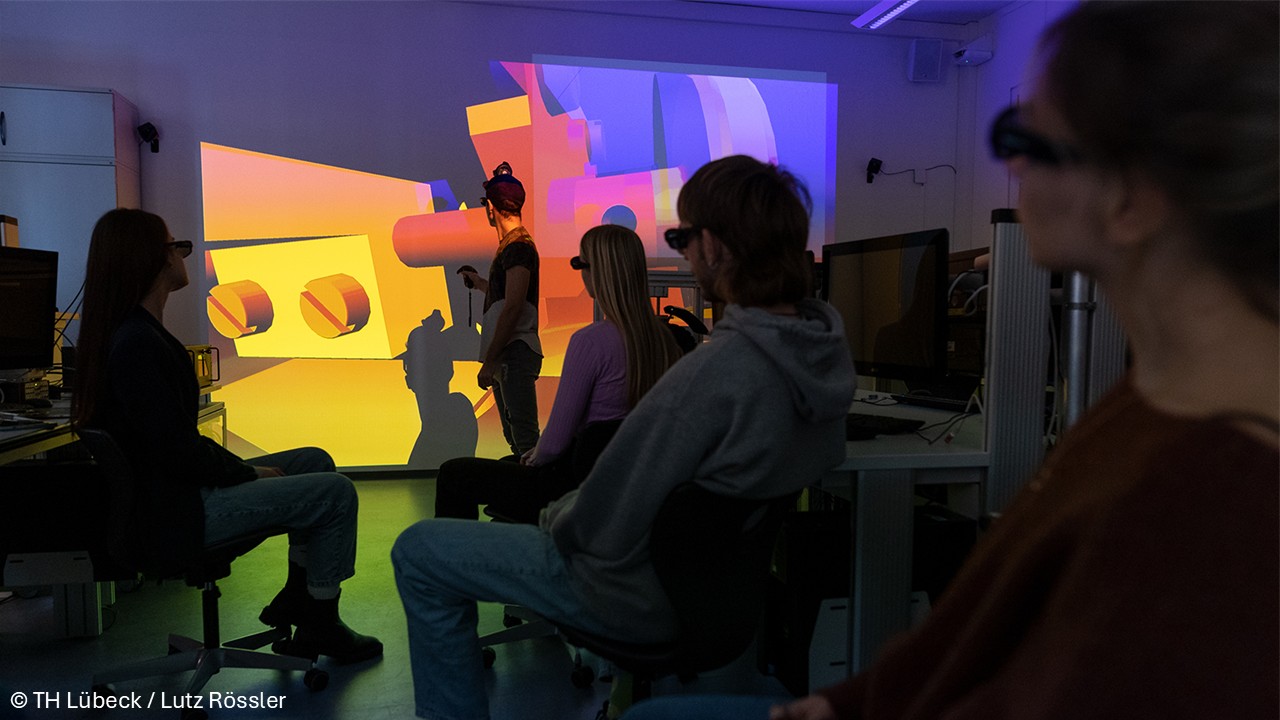
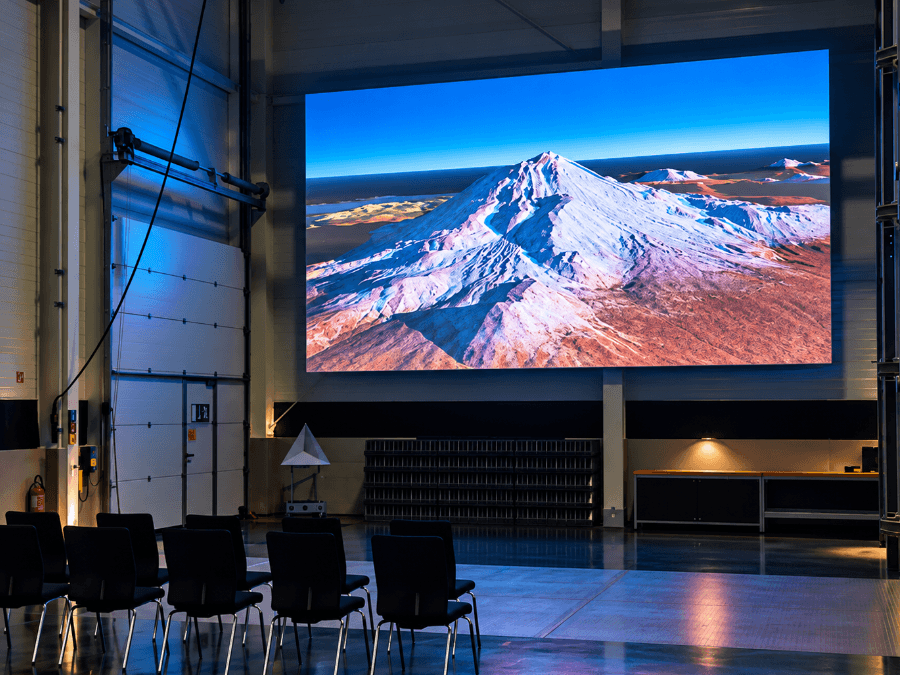
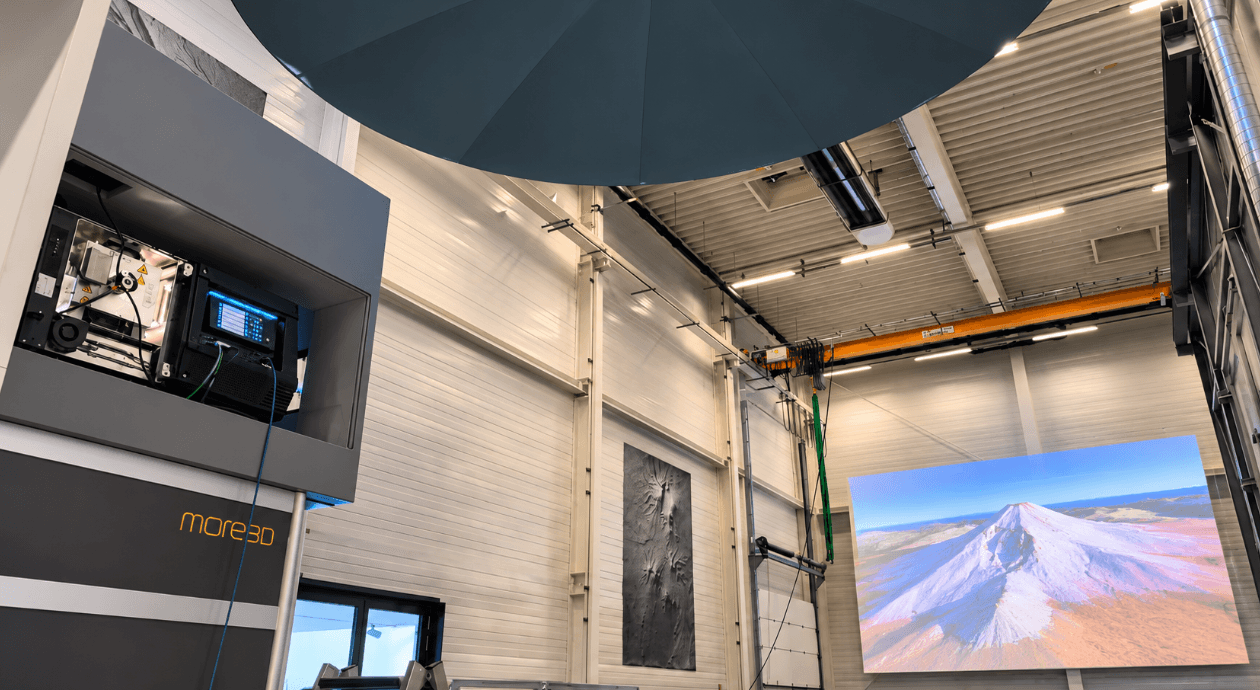
The projection had to cover an enormous screen inside a large hall, projecting over a distance of 24 meters onto an 8-meter-wide 16:9 screen — while maintaining enough brightness and contrast for stereoscopic 3D. At the same time, the system needed to handle highly dynamic scientific visualizations smoothly and reliably.
Numerous technologies were evauated before making a decision. According to the team, they even visited cinemas to compare image quality and stereoscopic projection approaches in real-world conditions. What they quickly discovered was that many conventional systems simply were not up to the challenge.
Eventually, a custom solution was implemented by more3D using Sanyo PLC-HF15000L projectors combined with INFITEC stereoscopic filter technology and moreMediaHD playback software.
At the time, the setup was highly advanced. more3D was the first company in Europe to deploy these newly released projectors together with a motorized INFITEC filter solution. And it fulfilled its purpose: helping people understand data instantly.
“more3D really listened to us, understood our needs, and came up with a customized solution that was perfect for us. They presented it to us at our location, and you could see their experience, but also their enthusiasm and passion for 3D.” — Project manager at the aerospace research institite
Making Invisible Data Tangible
Radar data is powerful precisely because it reveals things the human eye normally cannot see. But without the right visualization, much of that impact remains abstract for non-specialists. This is where stereoscopic presentations completely changed the experience.
“On a normal screen, you can only simulate depth with colors or shadows. But our datasets are fundamentally three-dimensional. To get the full information instantly, 2D is not sufficient.” — Project manager at the aerospace research institite
Instead of looking at flat scientific imagery, audiences suddenly experienced landscapes and datasets spatially. Terrain structures became intuitive. Depth became immediately recognizable. Environmental changes became easier to interpret.
And according to our client, the reactions were often remarkable.
“You can see in people’s reactions that it fascinates them. Even people unfamiliar with radar immediately understand what they are seeing.” — Project manager at the aerospace research institite
That effect became especially important during presentations for political representatives, funding institutions, and external visitors. As many research institute also our client is publicly funded and collaborates internationally on numerous scientific and technological projects. Communicating the societal relevance of this work is therefore essential.
And immersive visualization helped make that communication far more effective. The presentations often stayed in visitors’ memories long after they had left the facility. Even after attending many other presentations during the same day, the 3D presentation was often what people remembered most.
A 3D System Built for Long-Term Use
One of the most impressive aspects of the installation is not the image quality. It is the longevity. The system has now been in active operation since 2010. In the world of visualization technology, that is highly unusual. Many systems become outdated quickly or require complete replacement after only a few years.
The long operational lifetime is credited to a combination of careful planning, regular maintenance, trained personnel, and reliable long-term support. The maintenance support provided by more3D also played an important role throughout the years.
“That is something we truly appreciated with more3D: support was always very fast and delivered with real expertise. We could truly rely on them.” — Project manager at the aerospace research institite
In 2018, more3D modernized the projection setup with a Barco cinema projector using interference filter technology, significantly improving brightness and image quality while simplifying the projection architecture. The result was essentially cinema-quality stereoscopic visualization for scientific communication.
When Acoustics Became the Biggest Problem
Ironically, one of the biggest challenges had nothing to do with visualization itself. It was sound.
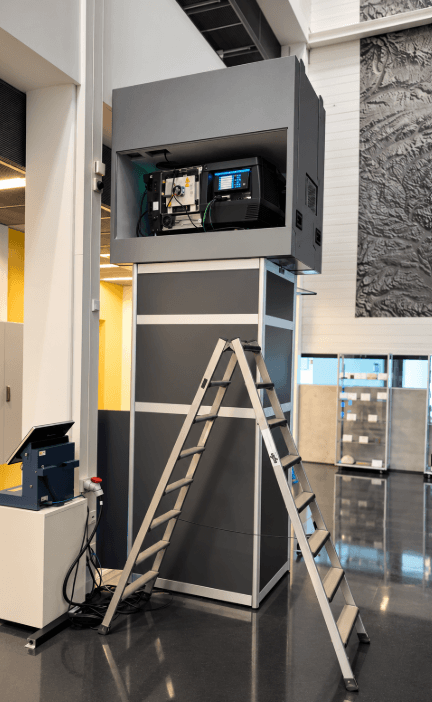
The powerful cinema projector generated substantial operating noise, and the acoustics of the large hall amplified the problem significantly during presentations. For audiences, the noise was quite distracting.
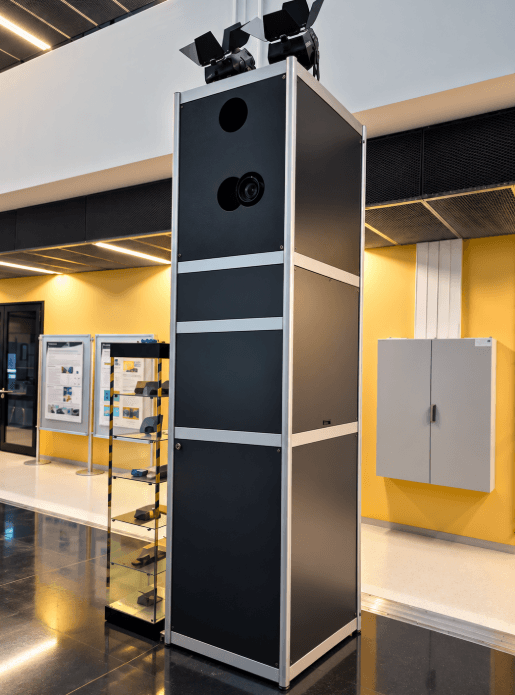
To solve the issue, more3D developed a custom sound insulation enclosure for the projector. The sound insulation was extremely effective. You could barely hear the projector anymore.
The timing turned out to be ideal. Shortly afterward, the presentation environment was used during a visit by Federal Minister of Research, Technology and Space Dorothee Bär. The feedback afterward was overwhelmingly positive.
Stereoscopic 3D — Practical Value Instead of Hype
For DLR, immersive visualization is not about trends or hype. It is about practical value.
The technology has a clear role wherever people need to understand complex spatial information quickly and intuitively. Humans naturally think in three dimensions anyway. The world is in 3D. Every 2D representation loses information and depth.
That applies not only to radar visualization, but also to areas like medical imaging, aircraft engineering, industrial design, and scientific simulation. In those kinds of professional environments, the value becomes very real very quickly and generates a clear return on investment.
Why Trust Matters in Complex Visualization Projects
When asked for lessons learned for organizations planning similar visualization environments, one point stood out: a trustworthy partner.
Professional stereoscopic visualization systems are highly specialized environments. They are not simple off-the-shelf products, because every project environment and set of requirements is different.
“It is important to work with a partner you can trust. Not someone who only wants to sell you something, but someone who provides a system that genuinely helps you. There should be transparency when it comes to pricing. And more3D proved to be such a partner for us.” — Project manager at the aerospace research institite
And the project continues evolving. Future upgrades together with more3D may include:
improved hall acoustics
enhanced loudspeaker systems
digital audio mixing
higher brightness projection
migration to newer Windows platforms
The stereoscopic system helps make complex data understandable. And more than 15 years after the original installation, that role remains just as relevant as ever.
Interested in Professional Visualization Solutions?
Whether for research institutions, engineering environments, scientific communication, or industrial applications — professional stereoscopic and VR solutions can help make complex information easier to understand and communicate. Learn more at more3D