A Case Study on TH Lübeck’s 3D Visualization
Engineering education has changed significantly over the past decades. And yet, one challenge remains surprisingly persistent: how do you make complex systems not just calculable — but truly understandable?
At Technische Hochschule Lübeck, this question is part of everyday teaching in mechatronics and control engineering. In industry, simulation tools are more powerful than ever, digital twins are widely used, and virtual testing environments have become standard in many sectors. TH Lübeck is preparing its students for exactly this environment.
This case study explores how Prof. Dr Martin Hahn and laboratory engineer Nikolai Schuljak at approached the gap between data and real understanding. It shows what happens when simulation is combined with real-time 3D visualization — and how this changes not only the way students learn, but also how engineering decisions are made and how it can prevent errors that are up to 100 times more costly.
Learning Engineering Through Models (or the background of the project)
For more than a decade, Prof. Hahn has been teaching model-based design at TH Lübeck. The principle is straightforward: instead of building physical systems first, engineers develop and test them digitally. These models — often referred to as digital twins — behave like real systems. They respond to inputs, simulate dynamics, and allow engineers to validate ideas before anything is manufactured.
In this environment, students do not just study finished systems. They work with evolving ones. They build models, adjust parameters, and observe behavior.
An example of a machine and its digital twin on a screen and in VR.
Supporting this setup is Nikolai Schuljak, who ensures that the technical infrastructure behind these workflows actually works in practice. Without a stable and usable environment, even the best teaching concepts remain theoretical.
At the center of this work is CAMeL-View (Computer-Aided Mechatronic Laboratory), an open-source engineering platform that allows students to model, simulate, and test mechatronic systems in real time. It forms the backbone of the entire workflow.
When Understanding Takes Too Long (or the challenge faced)
The challenge is not that students cannot understand these systems. They can. But the process often relies on interpreting abstract representations. In control engineering, for example, system behavior is typically described through curves, signals, and mathematical relationships. These are precise and indispensable tools — but they require interpretation. Students need to mentally convert these representations into spatial and physical understanding.
As Prof. Hahn puts it:
“If you cannot represent something spatially, it often remains abstract.”
For experienced engineers, this translation becomes easier over time—though it can still be time-consuming. For students, especially in early stages, it can be a real barrier. Spatial understanding, and the ability to intuitively grasp how a system behaves, usually develops slowly.
This is not a failure of the methods. It is simply a limitation of how humans process complex, abstract information.
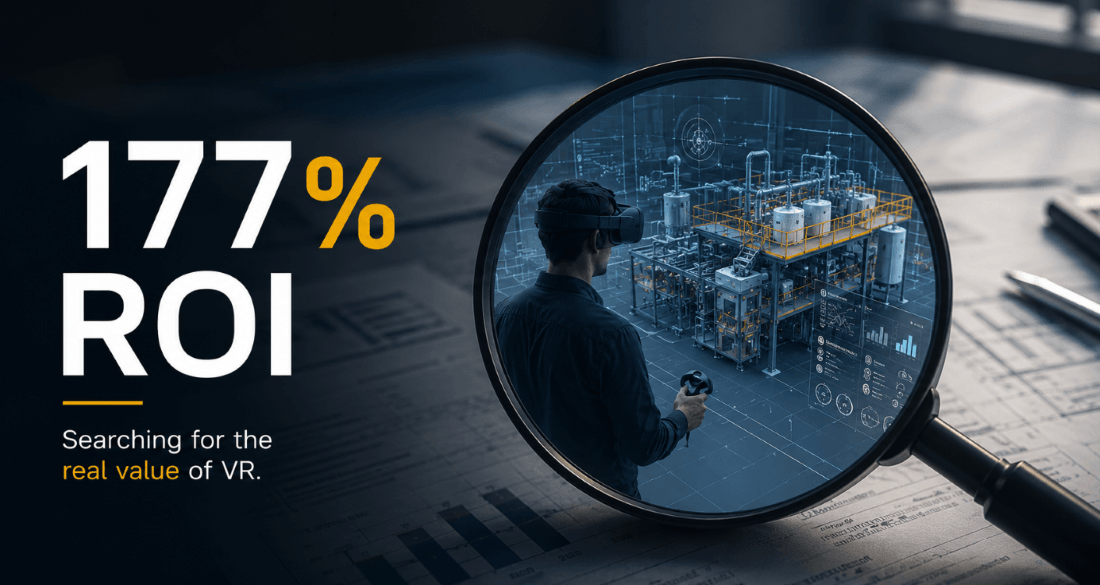
Why Timing Matters (or the importance of VR and 3D for the ROI)
This challenge becomes more critical when moving from education into real engineering practice.
A typical development process begins with defining requirements, followed by modeling and simulation, and eventually leading to physical prototypes. Ideally, most problems are identified early, when changes are still easy to implement.
In reality, however, many issues only become visible later.
This is where a well-known principle in engineering comes into play: the later an error is detected, the more expensive it becomes to fix. The increase is not gradual — it is exponential.
“If issues only appear in the prototype phase, the cost factor can be 100 times higher.” – Prof. Hahn
A simple example makes this tangible. Imagine designing a windshield wiper system. On a 2D screen, everything looks correct. The movement paths seem plausible. Only later, during testing, it becomes clear that the wiper collides with the windshield or does not function properly.
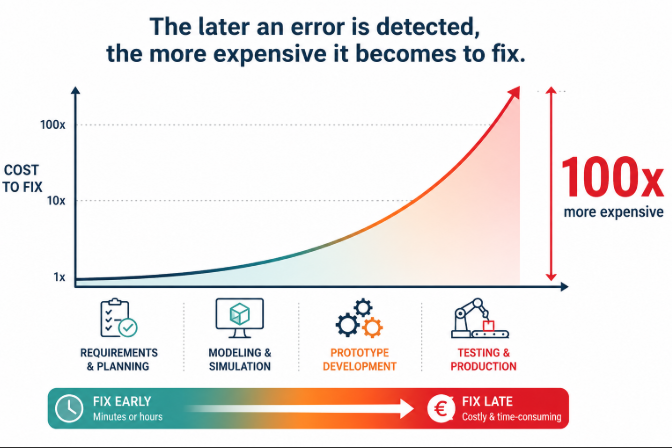
If this issue is detected early in the model, it can be fixed within minutes. If discovered during prototyping, it may require redesign, new parts, and delays in development.
The difference is not just technical — it is economic.
Making Complex Data and Systems Visible (or the developed solution)
To address this gap between simulation and understanding, TH Lübeck introduced a visualization layer into their existing workflow.
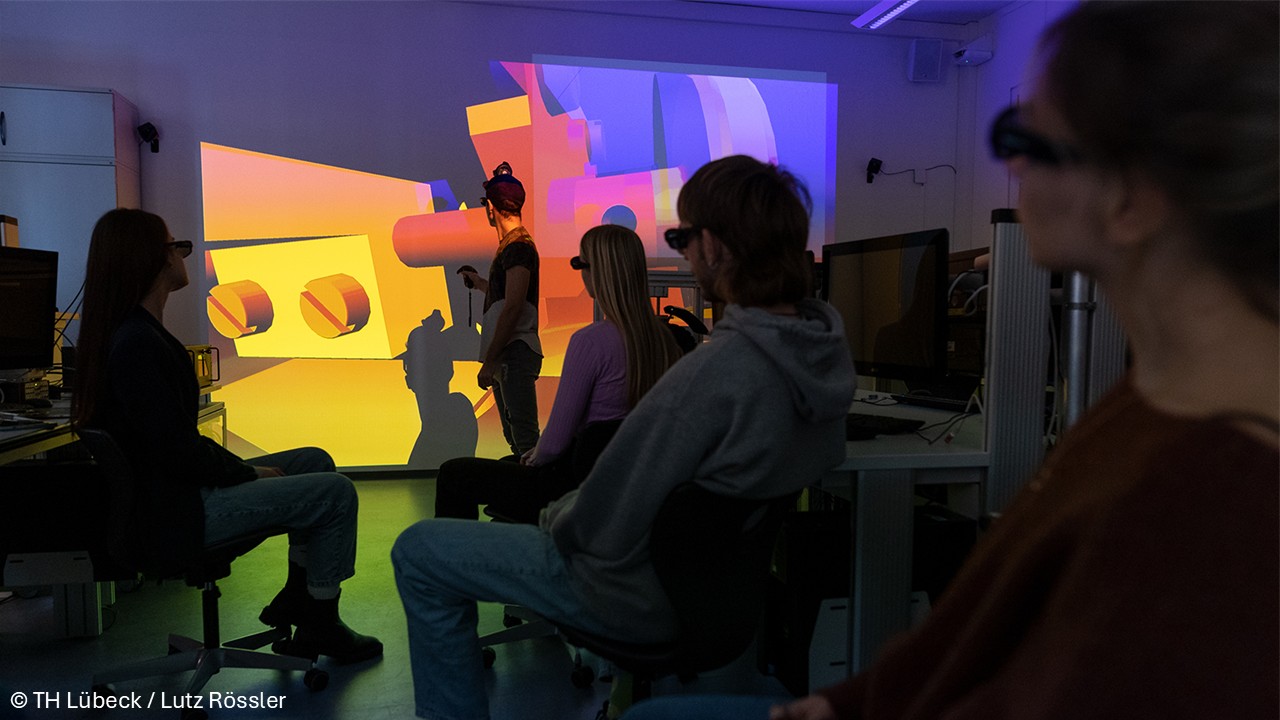
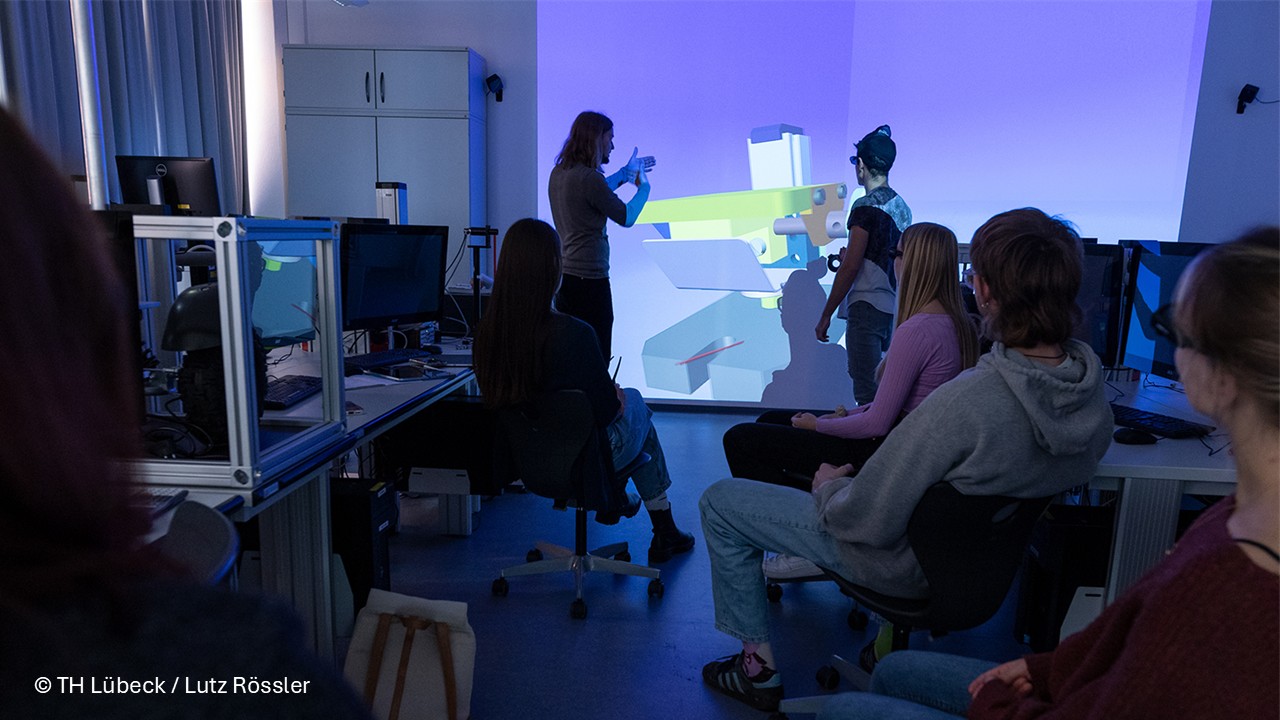
The setup includes, on the one hand, two large Powerwalls for group visualization, which have been in use for several years. During the last year, they added sixteen 3D workstations for individual student work. This unlocks new possibilities for personal exploration and improved learning effects. Initially, TH Lübeck was not sure whether such 3D monitors would meet their requirements, but the planning and implementation of this setup were carried out together with more3D, ensuring that all components worked seamlessly within the existing infrastructure.
The key, however, is not the hardware alone. It is how the system integrates into the existing workflow.
TH Lübeck relies on CAMeL-View, an open-source platform used to model mechatronic systems, simulate dynamic behavior, and run real-time experiments. This software already simplified 3D visualization significantly.
“With just a right click, the 3D visualization is ready — in less than a minute.” – Nikolai Schuljak
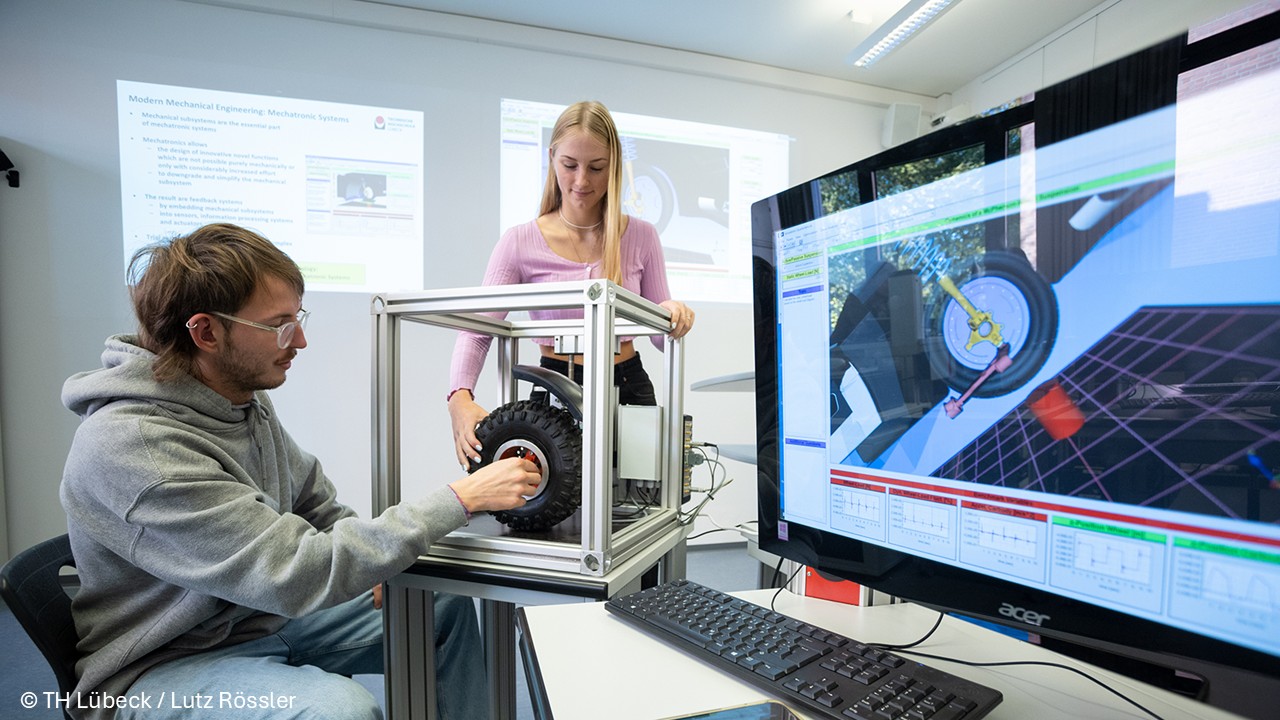
But in some use cases, more was required. This is where moreViz comes in.
Since TH Lübeck’s setup is based on custom workflows and specific requirements, standard solutions were not sufficient. The system had to work with CAMeL-View, support real-time simulation, and run on existing graphics cards due to budget constraints.
“Only more3D was able to provide a solution for our software — and adapt it to our needs.” – Prof. Hahn
Rather than delivering a predefined product, more3D approached the project as a technical partner. The focus was on understanding the requirements and finding workable solutions.
more3D’s software moreViz helps ensure that, with minimal effort, abstract data becomes spatial. It acts as a bridge from the application to a 3D or VR environment. Instead of requiring complex export processes or additional preparation, models can be visualized directly and in real time.
This simplicity is crucial. In a teaching environment, time is limited. If preparing models for visualization takes too long, the system becomes impractical. Here, the opposite is true — the visualization fits naturally into the workflow.
What made this possible was not just the technology, but the way the solution was developed.
One aspect repeatedly emphasized during the project was technical depth:
“They live OpenGL.” – Prof. Hahn
This was not a marketing phrase. It reflects the fact that integrating visualization into an OpenGL-based environment requires detailed technical knowledge. Without that, the system would not have worked.
Equally important was the communication. The collaboration was described as direct, uncomplicated, and fast. Problems were addressed pragmatically. Even constraints, such as using existing graphics hardware, were solved without unnecessary complexity.
In the end, this made the difference between a theoretical concept and a working system.
From Analysis to Experience (or the effects and benefits observed)
The impact of this approach becomes most visible in everyday teaching.
Instead of interpreting simulation results, students can interact with them. One example is a moon landing simulation. Using a joystick on a 3D monitor, students control a landing scenario in real time.
The setup is simple, but the effect is significant. Control behavior becomes intuitive. Cause and effect are immediately visible. Students are not just observing a system — they are experiencing it.
“One example is the comparison of active and passive suspension systems: You look at it once in VR — and immediately understand the difference.” – Prof. Hahn
What previously required explanation can now be grasped at a glance. Control engineering is full of abstract concepts: feedback loops, system dynamics, and stability. These are difficult to visualize and even more difficult to internalize.
With 3D visualization, these concepts gain a reference point in reality.
Students can see how systems move, how components interact, and how changes affect behavior.
“It creates a real-world reference for very abstract concepts.” – Prof. Hahn
The system also supports more advanced workflows, such as hardware-in-the-loop testing. In these scenarios, real hardware components are connected to simulations. Systems behave in real time, allowing validation under realistic conditions. For example a vehicle behaves in the simulation exactly as it would in reality on the Nürburgring.
This creates a bridge between digital models and physical systems. Students are not just learning concepts — they are working with systems that behave like real engineering applications.
The most noticeable change is not the technology itself, but the speed of understanding.
Students grasp concepts faster. They develop intuition earlier and engage more actively in the learning process.
“With 3D monitors, we can guarantee learning success within a short time.” – Prof. Hahn
For instructors, this also changes what can be taught.
“Without this solution, I couldn’t teach this aspect—the effort to prepare data would be too high.” – Prof. Hahn
Because the system is easy to use and requires minimal preparation, valuable teaching time is no longer spent on setup — it is spent on learning.
Beyond the Classroom (or additional benefits)
The impact is not limited to teaching. The system is also used to demonstrate the university’s capabilities to prospective students.
The visual experience plays an important role here.
“The 3D effect creates a much clearer picture — and it’s very impressive.” – Prof. Hahn
It shows that the university is working with modern tools and preparing students for real-world challenges.
Lessons Learned (or what is the critical success factor)
One of the clearest takeaways from the project is the importance of choosing the right partner.
“It is extremely important to have a partner who understands the technical background and adapts to your requirements.” – Nikolai Schuljak
This is not only about purchasing hardware or software. It is about building a solution that works in a specific context.
In this case, that meant:
adapting to custom software
working within budget constraints
integrating into existing workflows
providing technical expertise beyond standard solutions
Looking Ahead
The role of 3D and VR in engineering is likely to continue growing — not as a replacement for existing methods, but as an extension of them.
“It is an essential part of model-based engineering and education — and its importance will increase.” – Prof. Hahn
As systems become more complex, the ability to understand them quickly and intuitively will become even more important.
At TH Lübeck, the goal was not to introduce new technology for its own sake. It was to solve a practical problem: how to make complex systems understandable.
By combining simulation, digital twins, and real-time visualization, they created an environment where abstract concepts become tangible and learning becomes more efficient.
The result is not a fundamentally different way of engineering — but a more intuitive one.
Try it Yourself
CAMeL-View (free): https://camelview.org/
moreViz (14-day trial): https://www.more3d.com/
About more3D
more3D develops solutions for 3D and VR visualization in engineering, research, and education. The focus is on enabling real-time access to complex data — helping teams understand systems faster and make better decisions.