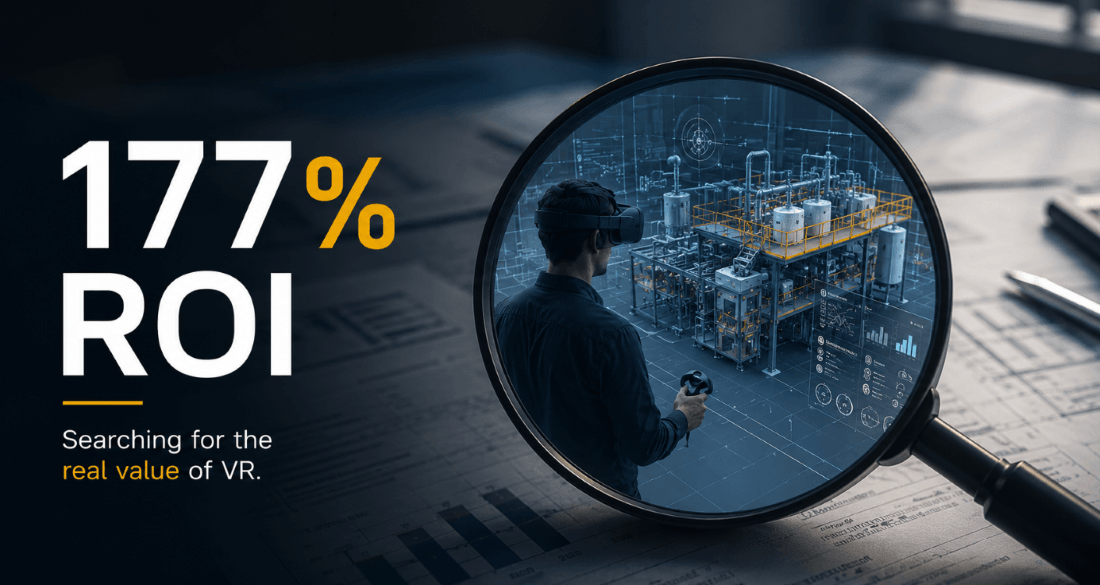
177% ROI. 4x Faster Training. Millions Saved in Downtime and Errors. So Why Are Many Companies Still Unsure About VR?
A Forrester study projected a 177% ROI over three years for mixed reality implementations. PwC found that VR training can be completed up to four times faster than traditional classroom learning. And in industries where a single production error, delayed field operation, or failed prototype can cost tens or even hundreds of thousands of euros, some companies report that avoiding just one major mistake already justified the investment.
And yet, in many management meetings, the reaction to VR is still surprisingly cautious. Not because people do not find it interesting.
But because there is a big difference between something being impressive and something being economically justified.
“VR sounds interesting. But where is the actual return?”
If you work in engineering, manufacturing, research, or education, you have probably heard some version of that sentence before. Maybe from management. Maybe from procurement. Maybe from yourself.
And honestly, it is a fair question.
Professional VR is not a gadget you order impulsively after lunch because somebody in the office saw a cool demo on LinkedIn. A serious VR setup often involves hardware, software, integration, support, planning, training, and internal resources. Which means that sooner or later, someone in the room asks: “Can we actually justify this financially?”
For a long time, that question was surprisingly difficult to answer clearly.
Not because VR had no value. But because many early projects focused more on technological fascination than measurable operational benefits. The result was often a very expensive demo room that impressed visitors twice a year before quietly collecting dust for the remaining 363 days.
That is also why VR developed a somewhat unfair reputation in some industries. Somewhere between gaming, metaverse hype, and futuristic marketing videos, many decision-makers quietly categorized VR as: “Probably interesting… but not essential.”
Meanwhile, something very different was happening behind the scenes. Companies dealing with expensive mistakes, complex spatial data, difficult training environments, and global collaboration problems kept using VR anyway.
Not because it looked futuristic. Because it solved problems.
The Important Part About the “177% ROI” Is Not the Headline
The famous Forrester Total Economic Impact study commissioned by Microsoft is often quoted because of one number: 177% ROI over three years
But what makes the study interesting is not the headline itself. It is the breakdown behind it. The reported value did not come from “immersive experiences.”
It came from measurable operational improvements.
The study was not based on a single company or theoretical assumptions alone. Forrester interviewed 23 decision-makers across 21 organizations already using mixed reality solutions with between 10 and 3,000 users across industries including manufacturing, architecture, healthcare, engineering, and education. In addition, Forrester conducted interviews with 13 mixed reality software vendors and 8 systems integrators, combined with third-party research, public market data, and Forrester analyst research.
Based on these findings, Forrester then created a so-called “composite organization” — a modeled enterprise with 1,500 employees representing a realistic average customer scenario — to calculate projected costs, savings, productivity improvements, downtime reductions, training efficiencies, and overall ROI over a three-year period.
The resulting ROI came mainly from the following operational areas:
1. Productivity Improvements
faster troubleshooting
reduced downtime
more efficient collaboration
remote expert assistance
faster field operations
Several of these categories individually generated multi-million-dollar projected impacts over three years.
2. Faster and More Effective Training
reduced onboarding time
lower training costs
less downtime during training
faster competency development
PwC separately found VR learners could complete training up to 4x faster than classroom learners.
3. Reduced Travel and On-Site Intervention
remote support
fewer expert travel requirements
faster issue resolution without physical presence
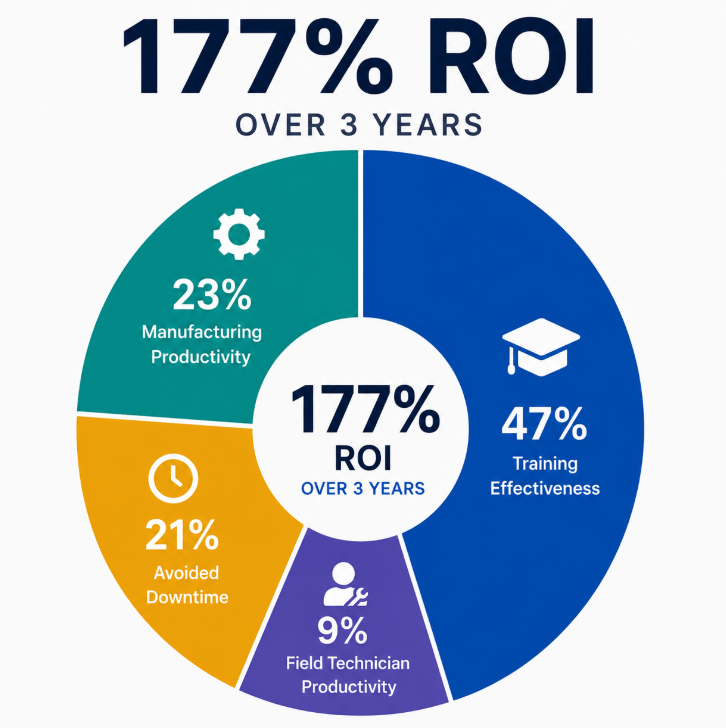
more than $4.5 million from improved training effectiveness
more than $2.2 million from improved manufacturing productivity
more than $2 million from avoided production downtime
around $1.8 million from improved field technician productivity
The companies seeing ROI from VR are usually not using it because it feels futuristic. They use it because it helps solve expensive practical problems faster and earlier.
The Biggest ROI of VR Often Comes From Problems That Never Happen
This is probably one of the most overlooked aspects of VR. The biggest value often comes less from what VR adds and more from what it prevents.
Imagine discovering during a virtual review that maintenance staff cannot actually access a critical machine component after installation. Solving that issue during planning may take a few minutes.
Discovering it after production starts may involve:
redesigns
delays
downtime
additional labor
and one extremely uncomfortable budget meeting
And in industries like manufacturing, automotive, aerospace, logistics, or energy, surprises tend to become very expensive very quickly.
Example Digital Twin: The real machine and its twin in 2D and VR. The usage of digital twins reduces delays and downtimes for the original machine as testing of modifications and maintenance and even training can be done on the virtual twin.
When Every Second in the Field Costs €1
One particularly interesting example comes from the Geomar VR DOME project together with more3D.
Deep-sea research is extraordinarily expensive. Research vessels, remotely operated vehicles, sensors, crews, and expedition logistics create enormous operational costs – in fact every second in the field costs €1. Once a mission ends, returning to the site is often difficult, time-consuming, or financially unrealistic.
That creates immense pressure to maximize the value of every collected dataset.
But GEOMAR faced several challenges:
valuable datasets were often difficult to reuse effectively afterward
understanding highly complex underwater structures on 2D screens was challenging
scientists, students, and external stakeholders often lacked the same spatial understanding
communicating findings to policymakers or researchers not present during the expedition was difficult
As a result, highly valuable datasets were often underutilized, limiting both scientific and operational impact. And this is where immersive visualization became highly valuable.
Instead of analyzing deep-sea environments purely through flat displays, teams could collaboratively step into spatial visualizations of the data itself. The value was not “VR for the sake of VR.” The value was:
improving understanding
increasing data usability
reducing interpretation barriers
improving communication
maximizing the long-term value of expensive field operations
In other words: Better understanding after the expedition means better return on the expedition itself.
You can read the full case study here: GEOMAR’s VR DOME.

Humans Are Surprisingly Bad at Understanding Space on Flat Screens
This sounds obvious. But it matters. Engineering teams spend enormous amounts of time reviewing 3D information on 2D displays. And while experienced engineers become very good at interpreting CAD data, spatial misunderstandings still happen constantly.
Customers misunderstand dimensions. Suppliers interpret layouts differently. Departments discuss the same project while imagining completely different realities.
VR changes this dynamic because people stop discussing abstract representations.
They experience the same environment together. And suddenly:
scale becomes obvious
accessibility problems appear naturally
workflow issues become easier to identify
design conflicts become much harder to ignore
Or as many engineers eventually realize after their first serious design review in VR:
“Wait… this looked much better on the monitor.” Which is precisely the point.
Training Is Becoming One of VR’s Strongest Business Cases
If there is one area where the ROI numbers are particularly convincing, it is training.
According to PwC’s research, employees trained in VR completed training up to four times faster than classroom learners while also reporting significantly higher confidence applying what they learned afterward.
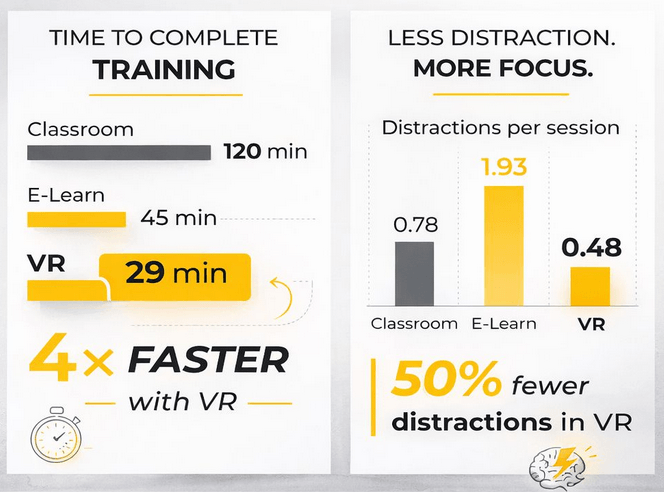
And once the surrounding costs are considered, the economics become much easier to understand. Traditional classroom training is expensive in ways companies often underestimate.
Not just because of instructors. But because training often also means:
travel
scheduling complexity
equipment downtime
repeated supervision
production interruptions
safety risks
material usage
Imagine a now manufacturing company – maybe even with different locations and branches – training employees annually on machine safety procedures.
Now imagine reducing training duration by even 40-50%. Suddenly, the savings are no longer theoretical. They become operationally measurable year after year. And unlike many technology investments, those savings compound continuously.
The other important factor is risk reduction.
Mistakes inside a virtual environment are usually much cheaper than mistakes involving real machines, production lines, hazardous environments, or expensive equipment. Procurement teams tend to appreciate that distinction very quickly.
Why Some VR Projects Still Fail
Of course, none of this means VR projects automatically succeed. Some fail completely. And interestingly, the reason is often surprisingly simple: The system becomes annoying to use.
This is one of the least glamorous but most important realities of enterprise VR.
If employees constantly need to:
export files manually
convert geometry
prepare sessions for long periods
switch between disconnected systems
fight unstable workflows
then adoption drops very quickly. People rarely reject technology because they hate innovation. They reject friction.
That is why ease of integration increasingly determines whether VR becomes a daily productivity tool or an expensive room nobody enters anymore after six months
This is also why workflow-focused solutions like moreViz concentrate heavily on bringing OpenGL-based applications directly into VR without complex conversion pipelines.
Technically, that may sound like a small detail. Economically, it is extremely important.
Usability strongly influences adoption. And without adoption, there is no ROI.
The Smartest VR Projects Usually Start Small
One misconception about enterprise VR is that companies need a massive installation immediately. In reality, many successful projects start surprisingly small.
The goal is not to “transform the company overnight.”
The goal is to identify where VR creates measurable operational value first.
A very good example is this case study where a single VR headset helped identify costly design flaws before production: See the Flaw Before You Build It – VR Case Study
That approach is often financially much smarter than immediately investing in large-scale systems without operational experience. And once the value becomes visible, scaling becomes far easier to justify.
Sometimes the best way to evaluate VR is not another PowerPoint presentation. It is simply testing your own data, your own workflows, and your own problems in an actual VR environment. Because that is usually where the real ROI discussion begins.
Curious Whether VR Could Create ROI in Your Own Workflow?
The best starting point is usually not a massive investment. It is testing real use cases with your own team and your own data.
Whether it is:
design reviews
factory layouts
training workflows
scientific visualization
maintenance planning
collaborative engineering
starting small often creates the clearest understanding of where VR delivers measurable value.
Learn more about practical VR workflows and immersive visualization at: more3D Official Website.
About the Author
This article was written by the team at more3D, a Germany-based company specializing in professional VR visualization and collaboration solutions for industry, engineering, science, and education.
With more than 25 years of experience in the 3D and VR market, more3D focuses on practical immersive workflows that integrate directly into existing applications and engineering environments. Their software solution, moreViz, enables companies and institutions to bring OpenGL-based applications into VR without complex conversion workflows, helping teams collaborate, review, and understand complex data more effectively.